

 Ask Me
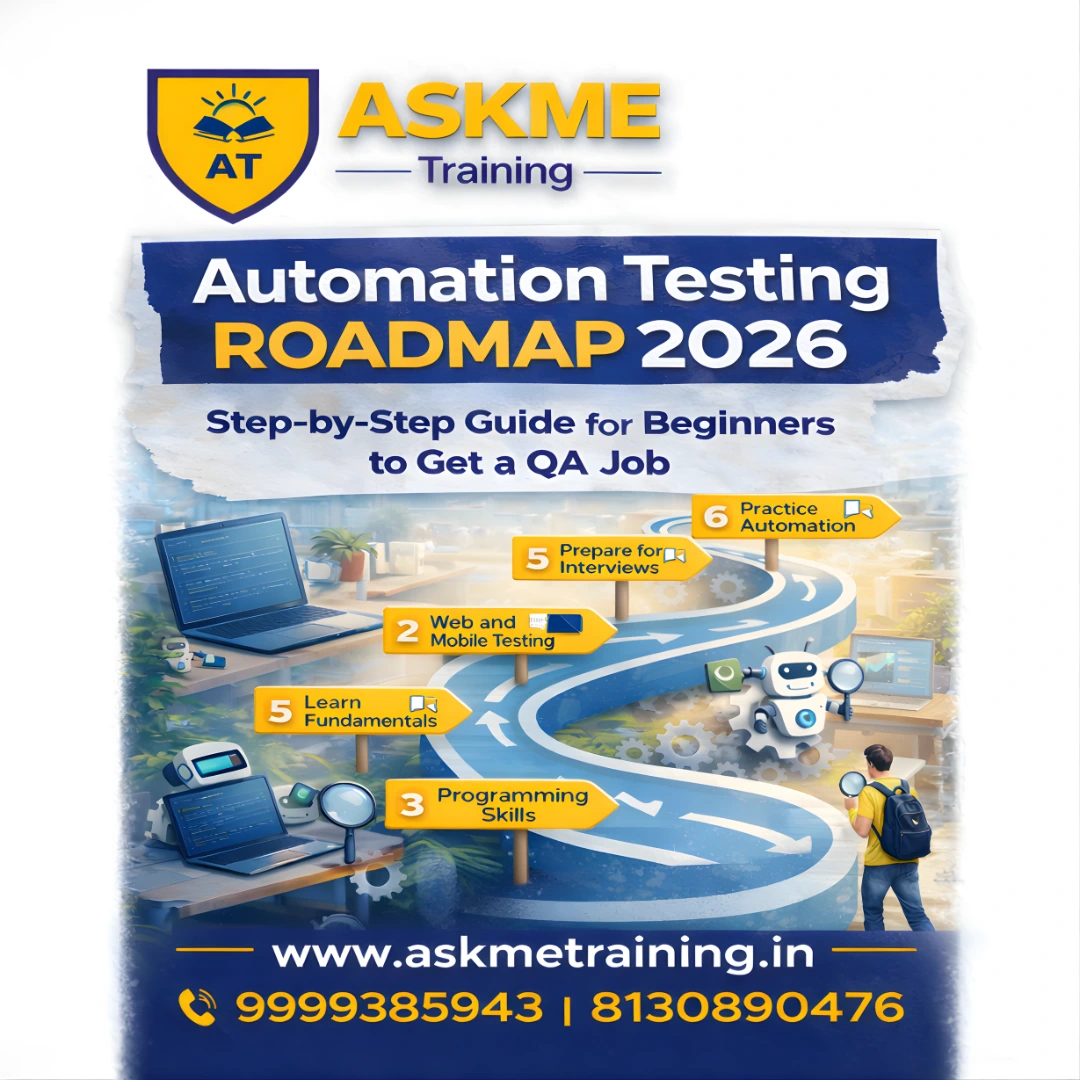
Automation Testing Roadmap 2026: Step-by-Step Guide for Beginners to Get a QA Job
- By Admin
- Posted on 02/01/2026
Automation testing has become one of the most in-demand skills in the software testing industry. As companies move faster with Agile, DevOps, and continuous delivery, manual-only testing roles are shrinking, while automation QA roles are growing rapidly. If you are a beginner planning to enter the IT industry or a manual tester aiming to upskill, this Automation Testing Roadmap 2026 will give you a clear, practical, and job-oriented path.
This guide is designed for beginners and focuses on what to learn, in what order, and why it matters—so you don’t feel lost or overwhelmed.
Why Automation Testing Is a Great Career Choice in 2026
In 2026, most organizations expect QA engineers to contribute beyond manual test cases. Automation testers are now involved in:
- Faster regression testing
- CI/CD pipeline validation
- Cross-browser and cross-device testing
- API and backend validation
Automation testing offers:
- Better salary growth than manual testing
- Long-term career stability
- Opportunities in product companies, startups, and MNCs
For beginners, starting with the right roadmap is the key difference between learning randomly and getting hired confidently.
Step 1: Understand Software Testing Fundamentals
Before jumping into automation tools, you must understand the basics of software testing. Automation without fundamentals leads to poor test design and unreliable scripts.
What you should learn:
- Software Development Life Cycle (SDLC)
- Software Testing Life Cycle (STLC)
- Types of testing (functional, regression, smoke, sanity)
- Test cases, test scenarios, and defect life cycle
- Black box testing techniques
These concepts help you think like a QA professional, not just a script writer.
Step 2: Learn Manual Testing Properly (Yes, It’s Important)
Many beginners try to skip manual testing, but companies still expect strong manual testing knowledge—even for automation roles.
Focus on:
- Writing clear and effective test cases
- Understanding real-time project workflows
- Using test management tools
- Exploratory testing techniques
Manual testing builds the logical foundation required to automate the right test scenarios later.
Step 3: Learn a Programming Language for Automation
Automation testing requires basic to intermediate programming knowledge. You don’t need to be a hardcore developer, but you must be comfortable with logic.
Recommended languages in 2026:
- Java – Widely used with Selenium and enterprise projects
- Python – Easy to learn and popular with PyTest and Playwright
- JavaScript/TypeScript – Essential for Cypress and Playwright
Start with:
- Variables, data types, loops, conditions
- Functions and methods
- OOP concepts (especially for Java)
This step usually scares beginners, but with consistent practice, it becomes manageable.
Step 4: Master Selenium for UI Automation
Selenium continues to be one of the most widely used automation testing tools in 2026.
What to learn in Selenium:
- Selenium WebDriver architecture
- Locators (XPath, CSS Selectors)
- Handling dynamic elements
- Wait strategies
- Browser interactions
Selenium is often combined with Java or Python and is still a must-have skill for QA jobs.
Step 5: Learn Modern Automation Tools (Playwright & Cypress)
To stay competitive in 2026, beginners should also understand modern automation tools.
Playwright:
- Faster execution
- Built-in waits
- Multi-browser support
- API + UI automation in one framework
Cypress:
- JavaScript-based
- Developer-friendly
- Great for frontend testing
Learning at least one modern tool along with Selenium increases your job opportunities.
Step 6: Understand Automation Framework Design
Companies don’t hire testers who only know how to write scripts. They look for candidates who understand framework design.
Key concepts:
- Page Object Model (POM)
- Data-driven testing
- Keyword-driven framework
- Hybrid frameworks
- TestNG / PyTest / JUnit
Framework knowledge shows that you can work on real-time automation projects, not just demos.
Step 7: Learn API Automation Testing
In 2026, backend and API testing is no longer optional.
Tools to learn:
- Postman (manual + automated API testing)
- REST Assured (Java)
- PyTest for APIs
Focus on:
- HTTP methods
- Status codes
- JSON validation
- Authentication mechanisms
API testing skills significantly boost your QA profile.
Step 8: CI/CD, Git & DevOps Basics
Automation testers are expected to work closely with DevOps teams.
Learn:
- Git (version control basics)
- Jenkins or GitHub Actions
- Running automation tests in CI pipelines
- Understanding build failures
Even basic CI/CD knowledge can set you apart during interviews.
Step 9: Work on Real-Time Projects & Test Scenarios
This is where many beginners fail—they learn tools but don’t apply them.
You should:
- Automate real websites
- Handle real-world challenges (dynamic elements, flaky tests)
- Create end-to-end automation flows
- Push code to GitHub
Training institutes like AskMe Training often emphasize real-time project exposure, which helps beginners understand how automation testing works in actual industry scenarios—without focusing only on theory.
Step 10: Prepare for Automation QA Job Interviews
Finally, focus on interview preparation.
Key areas:
- Automation concepts & frameworks
- Selenium/Playwright/Cypress questions
- Programming logic questions
- Real-time project discussion
- Test scenario explanation
Also, prepare a strong resume highlighting:
- Tools you used
- Framework knowledge
- Real-time project work
Is Automation Testing a Good Career for Beginners in 2026?
Absolutely. Automation testing continues to be one of the safest and fastest-growing IT career options. With the right roadmap, consistent practice, and real-time exposure, beginners can confidently crack QA automation roles—even without prior IT experience.
Final Thoughts
The key to success in automation testing is clarity and consistency. Don’t try to learn everything at once. Follow this Automation Testing Roadmap 2026, practice regularly, and focus on real-world application. With structured learning and the right guidance, getting a QA automation job in 2026 is completely achiev
