

 Askme Training
What Tools Do Business Analysts Use in Real-World Jobs?
- By Admin
- Posted on 08/10/2026
Have you ever wondered what a business analyst actually does at work?
Imagine you are working as a business analyst for an online shopping company. One day, your manager asks you, “Why have our sales gone down this month?” You cannot answer this question by simply looking at a few numbers.
You need to collect data, study it, find the reason, create a report, and explain your findings to the team.
This is where business analytics tools become important.
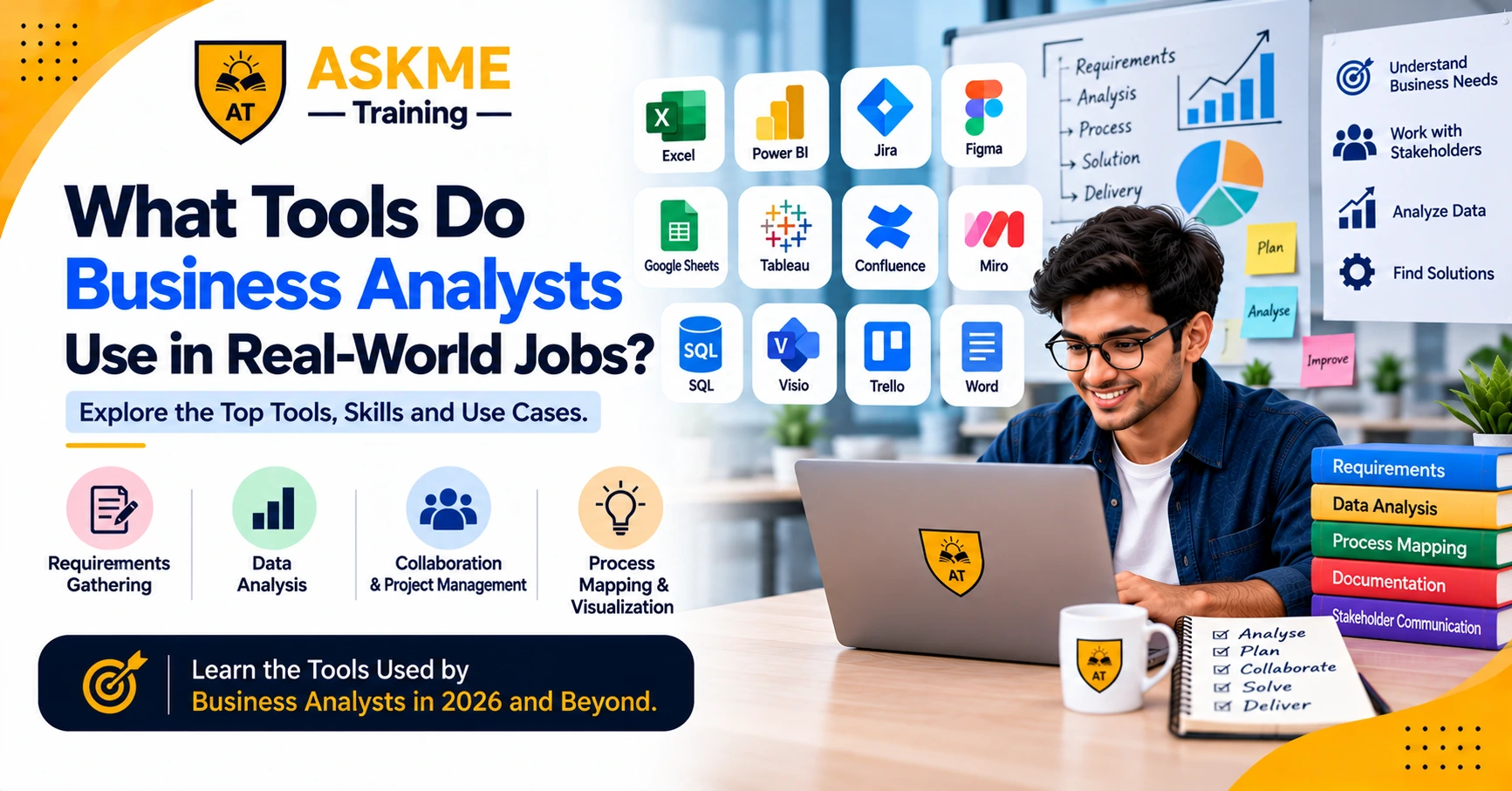
Business analysts use tools such as Excel, SQL, Power BI, Tableau, Python, Jira, and Google Analytics to work with data and solve business problems.
If you are planning to start a career in this field, learning these tools through a practical Diploma in Business Analytics in Noida can help you understand how analytics is used in real jobs.
Why Do Business Analysts Need So Many Tools?
A business analyst's job is not only about working with numbers. They also need to understand business problems, study information, prepare reports, communicate with different teams, and help companies make better decisions.
For example, a company may notice that its customers are buying fewer products.
A business analyst might:
1. Collect customer and sales data.
2. Use SQL to find useful information from the database.
3. Use Excel to organize and check the data.
4. Create a dashboard using Power BI.
5. Find important trends and problems.
6. Share the findings with the management team.
So, different tools are used for different parts of the job.
7 Tools Business Analysts Use in Real-World Jobs
1. Microsoft Excel
Excel is one of the first tools most beginners should learn.
Even with advanced analytics software available today, many companies still use Excel for everyday business work.
Business analysts use Excel to:
* Organize data
* Create reports
* Make charts
* Use formulas
* Create pivot tables
* Compare business results
* Find simple trends
For a beginner, Excel is a great way to become comfortable with data.
2. SQL
SQL is used to work with information stored in databases.
Think about a large online store with millions of customer and product records. Checking all those records manually would take a huge amount of time.
With SQL, an analyst can quickly find answers to questions such as:
“Which products sold the most last month?”
“Which customers made purchases more than once?”
This is why SQL is an important skill for many business and data analyst jobs.
3. Power BI
Power BI helps analysts turn data into easy-to-understand dashboards.
For example, instead of giving a manager a spreadsheet containing thousands of sales records, an analyst can create a dashboard showing:
* Total sales
* Monthly revenue
* Sales by location
* Best-selling products
* Sales targets
* Customer trends
The manager can look at the dashboard and understand the business situation much faster.
4. Tableau
Tableau is another popular tool used for creating charts, reports, and interactive dashboards.
It is especially useful when you need to explain a large amount of information visually.
For example, a company could use Tableau to compare sales across different cities and quickly identify which locations are performing well and which need attention.
Power BI and Tableau are both valuable skills. The tool you use will often depend on the company you work for.
5. Python
You may have heard that Python is mainly a programming language. That is true, but it is also useful in analytics.
Business and data analysts can use Python to work with large amounts of data, clean information, automate repetitive tasks, and perform deeper analysis.
You do not need to become a software developer to start using Python for analytics. Basic practical knowledge can be enough to get started.
6. Jira and Confluence
Business analysts don't spend all their time working with numbers.
If they work with software or product teams, they may use tools such as Jira and Confluence.
Jira can be used to track tasks, requirements, and project progress. Confluence is often used to write and organize project information.
For example, a business analyst may write the requirements for a new website feature and then use Jira to track its development.
7. Google Analytics and CRM Tools
Business analysts working with websites, marketing, or sales may also use Google Analytics and CRM tools.
These tools can help companies understand questions such as:
* How many people visit the website?
* Where do visitors come from?
* Which marketing campaign works best?
* Which customers are buying the most?
* Where are customers leaving the website?
These insights can help businesses improve their marketing and sales strategies.
How Should Beginners Learn These Tools?
If you are new to business analytics, don't try to learn everything at once.
A simple learning path is:
Step 1: Start with Excel.
Step 2: Learn SQL and understand how databases work.
Step 3: Learn Power BI or Tableau.
Step 4: Practice with real business examples.
Step 5: Learn basic Python.
Step 6: Understand business requirements and tools such as Jira.
Step 7: Create 2–3 practical projects for your portfolio.
A good Business Analytics Certification Course can help beginners follow this learning path in a structured way.
What Are the Benefits of Learning These Tools?
Learning industry-relevant tools can help you:
* Understand real business data
* Create professional reports
* Build useful dashboards
* Solve practical business problems
* Improve your analytical thinking
* Prepare for job interviews
* Create a strong project portfolio
* Feel more confident at work
The goal is not to learn 20 different tools. The goal is to know which tool to use, when to use it, and what business problem it can solve.
Career Opportunities in Business Analytics
Once you develop the right skills, you can explore several career options, including:
* Business Analyst
* Data Analyst
* Business Intelligence Analyst
* Reporting Analyst
* Operations Analyst
* Marketing Analyst
* Product Analyst
Your career growth will depend on your skills, practical experience, projects, communication abilities, and understanding of business.
Common Mistakes Beginners Should Avoid
One common mistake is trying to learn too many tools at the same time.
Another mistake is watching tutorials without actually practicing.
Remember, employers don't only want to know whether you have watched a Power BI tutorial. They want to know whether you can use Power BI to solve a real problem.
Also, don't ignore communication skills. A business analyst must often explain findings to people who may not have a technical background.
Expert Tip: Learn Tools by Solving Problems
The easiest way to understand business analytics tools is to use them on practical problems.
For example, imagine you are analyzing a retail company's sales.
Use Excel to organise the data, SQL to find key information, Power BI to build a dashboard, and your communication skills to explain what the company should do next.
This is much closer to the kind of work you may do in a real job.
Frequently Asked Questions
What tools do business analysts use?
Common tools include Excel, SQL, Power BI, Tableau, Python, Jira, Confluence, Google Analytics, and CRM platforms.
Is Excel enough for a business analyst?
Excel is a great starting point, but learning SQL, data visualization, business analysis, and communication skills can make you more job-ready.
Do business analysts need Python?
Not every business analyst job requires Python. However, Python can be useful for working with large datasets, automation, and advanced analysis.
Should I learn Power BI or Tableau?
Both are useful. Start with one, become comfortable using it, and then learn the other when you have a strong foundation.
Can a fresher become a business analyst?
Yes. Freshers can start by learning the right tools, building practical projects, improving communication skills, and preparing for interviews.
Is a Business Analytics Certification Course useful for beginners?
Yes. A practical course can give beginners a structured learning path and help them gain experience with tools and real-world projects.
Start Learning Business Analytics Today
You don't need to know everything before starting your business analytics journey.
Begin with the basics, practice regularly, work on real-world projects, and slowly build your skills.
If you are looking for a Diploma in Business Analytics in Noida, Askme Training Institute can help you develop practical skills and understand how business analytics tools are used in real work.
Ready to take the next step?
Visit Askme Training Institute to explore the available training programs and start building your business analytics skills.
