

 Askme Training
Is SQL More Important Than Python for a Data Science Career?
- By Admin
- Posted on 13/11/2026
Imagine you have landed your first data science interview. The interviewer asks you to retrieve customer records from a database, clean the information and build a model to predict customer behaviour. You know Python, but struggle with SQL queries. Does that mean you are not ready for the job?
This situation highlights a common question among aspiring data scientists: Is SQL more important than Python for a data science career?
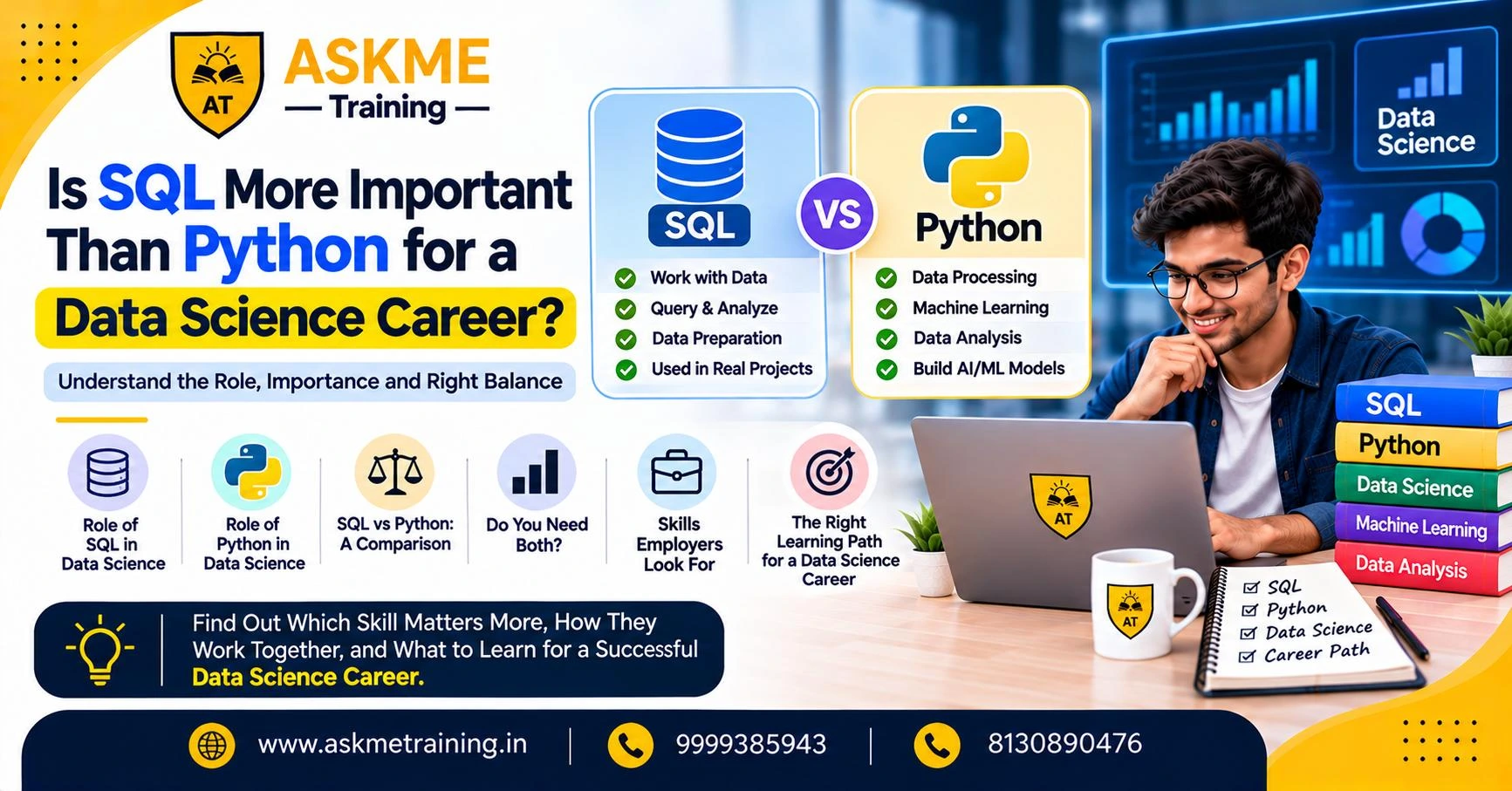
Both SQL and Python are essential skills, but they serve different purposes. SQL helps you access and manage data, while Python allows you to analyse data, automate tasks and build machine learning models.
If you are planning to enrol in a Data Science Course with Placement in Noida, understanding the importance of both languages can help you prepare for real-world industry requirements.
What Is More Important for Data Science: SQL or Python?
Short answer: SQL is essential for retrieving and managing structured data, while Python is important for data analysis, automation and machine learning. Neither completely replaces the other.
Their importance depends on the responsibilities of your job.
• SQL: Extracts, filters, joins and manages information stored in databases.
• Python: Cleans, analyses and visualises data and develops predictive models.
• Together: Help data scientists transform raw information into meaningful business insights.
For example, an e-commerce company may use SQL to retrieve customer purchase records and Python to predict which customers are likely to purchase again.
Why Is SQL Important for a Data Science Career?
Most organisations store business information in databases. Customer details, transactions, sales records and product information need to be retrieved before meaningful analysis can begin.
This is where SQL becomes valuable.
Key benefits of learning SQL
1. Data extraction: Retrieve relevant information from large databases.
2. Data filtering: Use WHERE, ORDER BY and GROUP BY to organise records.
3. Data joining: Combine information from multiple tables using JOIN operations.
4. Data aggregation: Calculate revenue, average sales and customer counts.
5. Business reporting: Prepare datasets for dashboards and analytical reports.
Practical example: Suppose a company wants to identify its top-performing products. A data scientist can use SQL queries to retrieve sales information, calculate total revenue and identify the best-selling products.
Learning SQL gives beginners an important foundation for working with real business data.
Why Is Python Important for Data Science?
While SQL helps you retrieve information, Python helps you explore what that information actually means.
Python is widely used in data science because of its simple syntax, extensive libraries and flexibility.
Important Python libraries for data science
• Pandas: Data cleaning, manipulation and analysis.
• NumPy: Numerical calculations and scientific computing.
• Matplotlib and Seaborn: Data visualisation.
• Scikit-learn: Machine learning algorithms.
• TensorFlow and PyTorch: Deep learning applications.
Practical example: Imagine a bank wants to identify customers who may stop using its services. A data scientist can use Python to analyse customer behaviour, identify patterns and develop a machine learning model to predict customer churn.
Python makes it possible to move beyond basic reporting and develop intelligent solutions.
SQL vs Python: Which Should Beginners Learn First?
If you are completely new to programming, deciding where to start can feel confusing.
Here is a simple comparison:
Factor SQL Python
Main purpose Database management and querying Analysis and programming
Learning curve Relatively easy to start Requires programming fundamentals
Data handling Structured database data Structured and unstructured data
Machine learning Limited direct use Extensive capabilities
Reporting Data extraction and aggregation Analysis and visualisation
Career applications Data Analyst, BI Analyst Data Scientist, ML Engineer
Our recommendation: Start with basic SQL and Python fundamentals together. Develop stronger SQL querying skills before progressing towards advanced Python libraries and machine learning.
How to Learn SQL and Python for a Data Science Career: Step-by-Step Guide
Instead of trying to master everything simultaneously, follow a structured learning roadmap.
Step 1: Understand basic SQL
Learn SELECT, WHERE, GROUP BY, ORDER BY, JOIN, subqueries and aggregate functions.
Step 2: Build Python fundamentals
Understand variables, data types, loops, functions, conditional statements and basic programming concepts.
Step 3: Practise data analysis
Work with Pandas and NumPy to clean datasets, handle missing values and identify patterns.
Step 4: Learn data visualisation
Use Matplotlib and Seaborn to present information through meaningful charts and graphs.
Step 5: Explore statistics and machine learning
Understand probability, descriptive statistics, regression, classification and clustering.
Step 6: Build practical projects
Try projects such as:
• Customer sales analysis using SQL and Python.
• Employee attrition prediction.
• Customer segmentation.
• Sales forecasting using historical data.
These projects help demonstrate your practical knowledge during interviews.
Benefits of Learning SQL and Python Together
Learning both technologies gives aspiring data scientists a stronger technical foundation.
Key benefits include:
• Better understanding of the complete data analysis process.
• Ability to work with real-world business datasets.
• Improved problem-solving and analytical skills.
• More opportunities across analytics and data science roles.
• Stronger project portfolios for job applications.
• Better preparation for technical interviews.
Rather than choosing one language over another, focus on understanding how they complement each other.
Career Opportunities After Learning SQL and Python
SQL and Python skills can support several career paths, depending on your additional technical knowledge and experience.
Potential job roles include:
• Data Analyst
• Junior Data Scientist
• Business Intelligence Analyst
• Machine Learning Engineer
• Data Engineer
• Business Analyst
For freshers, developing database knowledge, programming fundamentals, statistics and practical project experience can make the transition into the data industry more manageable.
If you are searching for an online data science training in Noida with certification, prioritise programmes that combine technical concepts with hands-on projects and interview preparation.
Common Mistakes Beginners Should Avoid
Many learners spend months watching tutorials but struggle to apply their knowledge.
Avoid these common mistakes:
1. Learning Python while completely ignoring SQL.
2. Memorising syntax without understanding practical applications.
3. Skipping statistics and mathematics fundamentals.
4. Depending entirely on ready-made projects.
5. Ignoring data cleaning and preprocessing.
6. Building a resume without demonstrating project experience.
Expert tip: Spend more time solving real data problems than simply watching lessons. Practical experience helps you understand how SQL and Python work together in professional environments.
Frequently Asked Questions (FAQs)
Q1. Is SQL more important than Python in data science?
SQL is essential for retrieving and managing database information, while Python is important for analysis and machine learning. Both are valuable for a data science career.
Q2. Can I become a data scientist by learning only Python?
You can develop strong analytical and machine learning skills with Python, but SQL is also important because many organisations store their data in relational databases.
Q3. Should freshers learn SQL or Python first?
Freshers can begin with SQL fundamentals and basic Python simultaneously. Gradually build practical skills in both technologies.
Q4. Is SQL difficult for beginners?
SQL is generally beginner-friendly because its commands use relatively straightforward, structured syntax. Regular query practice makes it easier to understand.
Q5. Is Python compulsory for a data science career?
Python is not the only programming language used in data science, but it is one of the most widely used because of its libraries and machine learning ecosystem.
Q6. What projects should beginners build using SQL and Python?
Beginners can create sales analysis, customer segmentation, employee attrition and customer churn prediction projects to demonstrate their practical skills.
Q7. Can I learn data science online and get a job?
Yes. Online learning can help you develop relevant skills, provided you practise consistently, complete real-world projects and prepare for technical interviews. Employment also depends on your skills, experience and interview performance.
Start Your Data Science Career with Askme Training Institute
Choosing between SQL and Python should not be your biggest concern. The real goal is to learn how to use both technologies to solve business problems.
At Askme Training Institute, aspiring data professionals can work towards developing industry-relevant skills through structured learning, practical projects and interview preparation.
If you want to build a career in data science, explore our training programmes and take the first step towards your professional goals.
Ready to start learning Data Science?
• Explore: https://www.askmetraining.in/
• Connect with Askme Training Institute to understand the course curriculum.
• Enquire about practical training, certification and placement assistance.
Learn the skills. Build real projects. Prepare for your next career opportunity!
