
 Askme Training
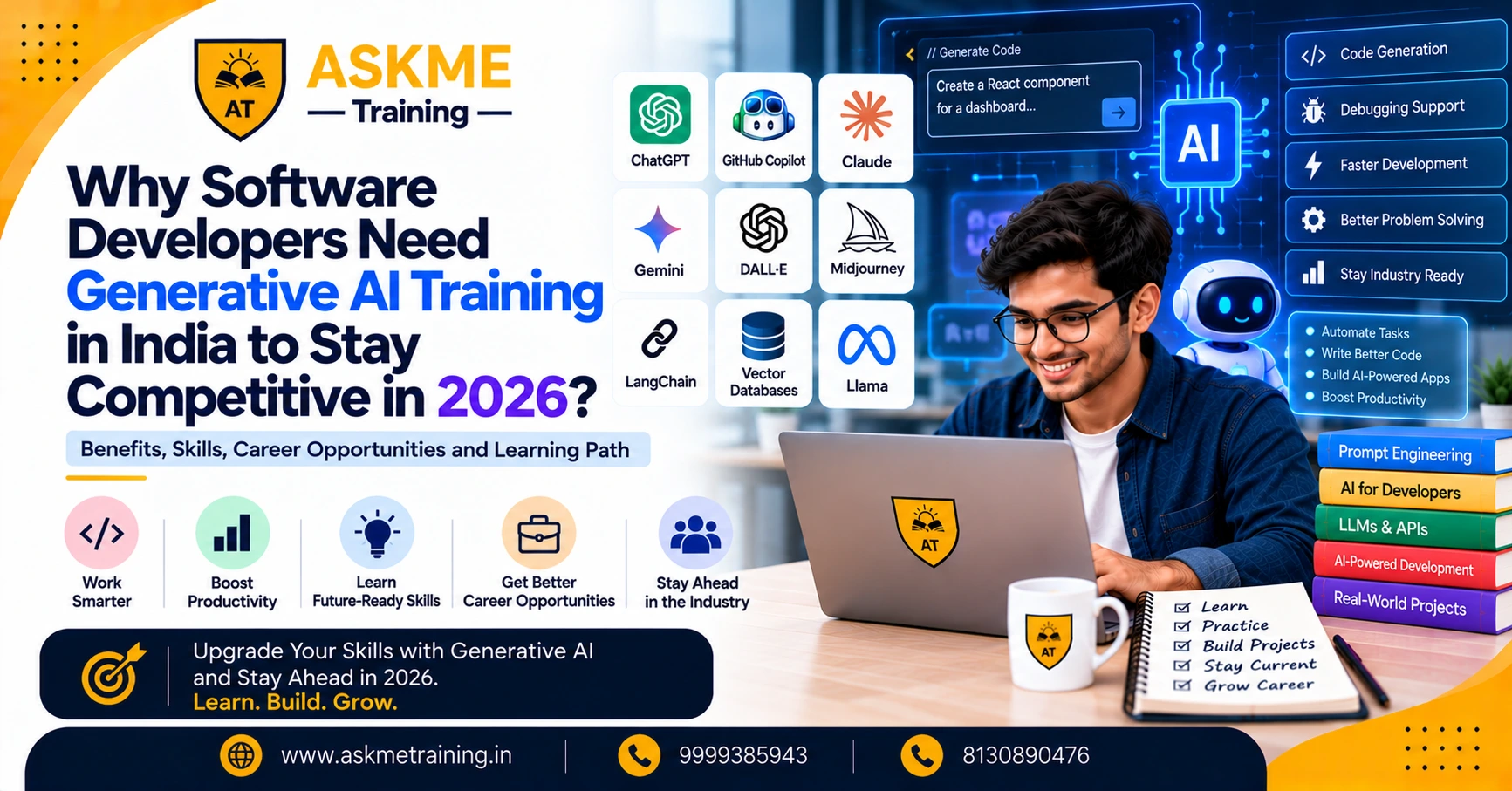
Why Software Developers Need Generative AI Training in India to Stay Competitive in 2026
- By Admin
- Posted on 26/10/2026
Imagine two software developers working on similar projects. One spends hours writing repetitive code, debugging errors, and preparing documentation. The other uses AI-powered tools to generate code suggestions, identify potential bugs, automate routine tasks, and accelerate development. Both have technical skills, but the second developer knows how to use artificial intelligence effectively.
This is how software development is evolving in 2026. Generative AI is changing how applications are designed, developed, tested, and maintained. For developers who want to remain competitive, Generative AI Training For Software developers in India can be a valuable step toward building relevant skills and adapting to changing industry expectations.
What Is Generative AI in Software Development?
Generative AI is a type of artificial intelligence that can create new content, including code, text, images, and other outputs, based on user instructions and learned patterns.
In software development, Generative AI tools can help developers:
• Generate code snippets and explain existing code.
• Identify potential errors and suggest debugging approaches.
• Create unit tests and test data.
• Draft technical documentation.
• Understand unfamiliar programming frameworks.
• Build prototypes and AI-powered applications.
For example, a Python developer building a customer support application could use an AI assistant to draft a chatbot function, explain its logic, and suggest test cases. The developer must still review the output, validate its accuracy, and ensure the code meets security and performance requirements.
Why Do Software Developers Need Generative AI Training in India in 2026?
India's technology sector continues to evolve, with businesses exploring AI-powered solutions across software development, finance, healthcare, e-commerce, and other industries. Developers who understand both programming fundamentals and AI-assisted workflows can be better prepared to contribute to these projects.
Here are four important reasons to learn Generative AI.
1. Improve Coding Productivity
AI coding assistants can help with repetitive programming tasks, code explanations, and initial implementations. Developers can use the time saved to focus on system design, complex problem-solving, and application quality.
2. Stay Relevant in a Changing Job Market
Employers increasingly value professionals who can adapt to new tools and workflows. Generative AI knowledge can strengthen a developer's existing technical profile, although job requirements vary by role and company.
3. Build Smarter Applications
Developers can use large language models (LLMs), APIs, and retrieval-augmented generation (RAG) to create applications that answer questions, summarize documents, or interact with business information.
4. Expand Career Opportunities
Generative AI skills can support a transition toward AI application development, LLM integration, intelligent automation, and related technical roles. Practical ability matters more than simply completing a course.
Benefits of a Generative AI Course With Real-World Projects
A generative AI course with real-world projects helps learners move beyond theory and understand how AI concepts work in practical applications.
Key benefits include:
• Hands-on learning: Apply AI concepts by building working applications.
• Stronger problem-solving: Learn to evaluate AI-generated code and troubleshoot issues.
• Portfolio development: Demonstrate your skills through projects on GitHub or a personal portfolio.
• Better interview preparation: Explain your technical decisions, implementation methods, and project outcomes.
• Practical tool experience: Understand how to work with AI APIs, prompts, and development frameworks.
For instance, building a document-question-answering application can teach you how to process documents, generate embeddings, retrieve relevant information, and use an LLM to produce contextual answers.
How to Start Learning Generative AI: A Step-by-Step Guide
If you are new to Generative AI, follow this practical learning path.
Step 1: Strengthen your programming fundamentals. Learn Python or another suitable programming language, along with functions, data structures, APIs, and basic software development practices.
Step 2: Understand AI and LLM fundamentals. Learn what large language models are, how tokens and context windows work, and why AI responses can sometimes be inaccurate.
Step 3: Practise prompt engineering. Learn to provide clear instructions, relevant context, examples, and output requirements to obtain more useful results.
Step 4: Explore AI APIs and frameworks. Understand how to integrate language models into applications and work with structured outputs, embeddings, and retrieval-based systems.
Step 5: Build practical projects. Start with a simple chatbot, then progress to a document assistant or an AI-powered coding helper.
Step 6: Test and improve your applications. Evaluate response quality, protect sensitive information, handle errors, and check outputs for reliability.
Step 7: Showcase your work. Document your projects, explain their architecture, and describe the problems they solve.
Career Opportunities After Generative AI Training
Generative AI training can help software developers explore several career paths, depending on their programming experience, project portfolio, and understanding of AI systems.
Potential roles include:
• Generative AI Application Developer: Builds applications using LLMs and AI APIs.
• AI Engineer: Develops and integrates AI-powered systems.
• LLM Application Engineer: Works with language models, prompt design, and retrieval systems.
• AI Automation Developer: Creates workflows that combine AI with business processes.
• Software Developer With AI Skills: Uses AI-assisted tools to improve conventional software development.
• AI Solutions Developer: Helps design AI-based solutions for specific business requirements.
Some positions require additional expertise in machine learning, mathematics, cloud infrastructure, or production deployment. A training course is a starting point, not a guarantee of employment.
Common Mistakes to Avoid While Learning Generative AI
Many learners become excited about AI tools but overlook the fundamentals. Avoid these common mistakes:
• Depending entirely on AI-generated code without understanding it.
• Ignoring programming, data handling, and debugging skills.
• Building projects without testing accuracy or security.
• Copying tutorials without understanding the underlying concepts.
• Adding AI tools to a resume without being able to explain your work.
Expert tip: Treat Generative AI as a development assistant, not a replacement for technical judgment. Always review generated code, validate outputs, and follow responsible data-handling practices.
Frequently Asked Questions (FAQs)
1. Why is Generative AI training important for software developers in India?
It helps developers understand AI-assisted coding, LLM integration, prompt engineering, and AI application development. These skills can improve productivity and support career growth as organisations adopt AI-powered workflows.
2. Can beginners learn Generative AI?
Yes. Beginners can start with programming fundamentals, basic AI concepts, and prompt engineering before progressing to APIs and practical projects. Python is a useful starting language.
3. Is a generative AI course with real-world projects worth it?
It can be valuable because projects help learners apply concepts, troubleshoot problems, and demonstrate practical skills to potential employers.
4. Do software developers need machine learning knowledge to learn Generative AI?
Not always. Developers can begin by integrating existing LLMs through APIs. Deeper machine learning knowledge becomes more important for roles involving model training, fine-tuning, and advanced AI research.
5. Which projects should I build during Generative AI training?
Start with an AI chatbot, a document summarizer, a question-answering application using RAG, or an AI coding assistant. Choose projects that demonstrate practical problem-solving.
6. What career opportunities are available after Generative AI training?
Possible pathways include Generative AI application development, LLM application engineering, AI automation, and software development with AI integration skills. Requirements differ across employers.
7. How long does it take to learn Generative AI?
The timeline depends on your programming background, learning schedule, and project complexity. Developers with programming experience may progress faster than complete beginners, but building reliable applications requires continued practice.
Start Your Generative AI Learning Journey With Askme Training Institute
The future of software development is not just about writing code faster. It is about solving problems intelligently, building useful applications, and knowing when and how to use AI responsibly.
If you want to strengthen your technical skills, explore Generative AI Training for software developers in India and focus on practical learning that connects concepts with real development challenges.
At Askme Training Institute, you can explore training opportunities designed to help learners develop industry-relevant skills through structured learning and practical application.
Ready to take the next step? Visit https://www.askmetraining.in/ to explore available courses and contact the team to discuss your learning goals. Start building the skills that can help you approach software development with greater confidence in 2026.
