
 Askme Training
What Should Software Developers Learn Before Starting Generative AI?
- By Admin
- Posted on 13/10/2026
Generative AI is changing how software developers build applications, automate tasks, and solve real-world problems. From intelligent chatbots to AI-powered coding assistants, developers can now create applications that understand questions, generate content, and improve user experiences.
But what should software developers learn before starting Generative AI?
The good news is that you do not need to be an AI expert to begin. A basic understanding of programming, APIs, and data handling can help you get started. Choosing the right Generative AI Training For Software Developers in India can also help you develop practical skills and build AI-powered applications.
In this guide, we will explore the essential skills, learning steps, benefits, and career opportunities for software developers interested in Generative AI.
What Is Generative AI?
Generative AI is a type of artificial intelligence that creates new content, such as text, images, code, and summaries, based on patterns learned from data.
For example, developers can use Generative AI to build customer support chatbots, document summarizers, and applications that explain programming errors.
Many applications use large language models (LLMs), APIs, prompt engineering, and retrieval-augmented generation (RAG) to deliver these features.
Why Should Software Developers Learn Generative AI?
Software developers already understand programming logic, debugging, and application development. Generative AI helps them apply these skills to new types of software.
Key benefits include:
• Build smarter applications: Add AI chatbots, intelligent search, and content generation to existing products.
• Automate repetitive tasks: Create tools for summarizing documents and extracting information.
• Improve productivity: Use AI coding assistants while checking their suggestions carefully.
• Expand technical skills: Combine software development with AI model integration.
• Explore career opportunities: Prepare for roles involving AI application development.
Learning Generative AI is not just about writing prompts. Developers must also understand how to connect models to applications, test their outputs, and manage security risks.
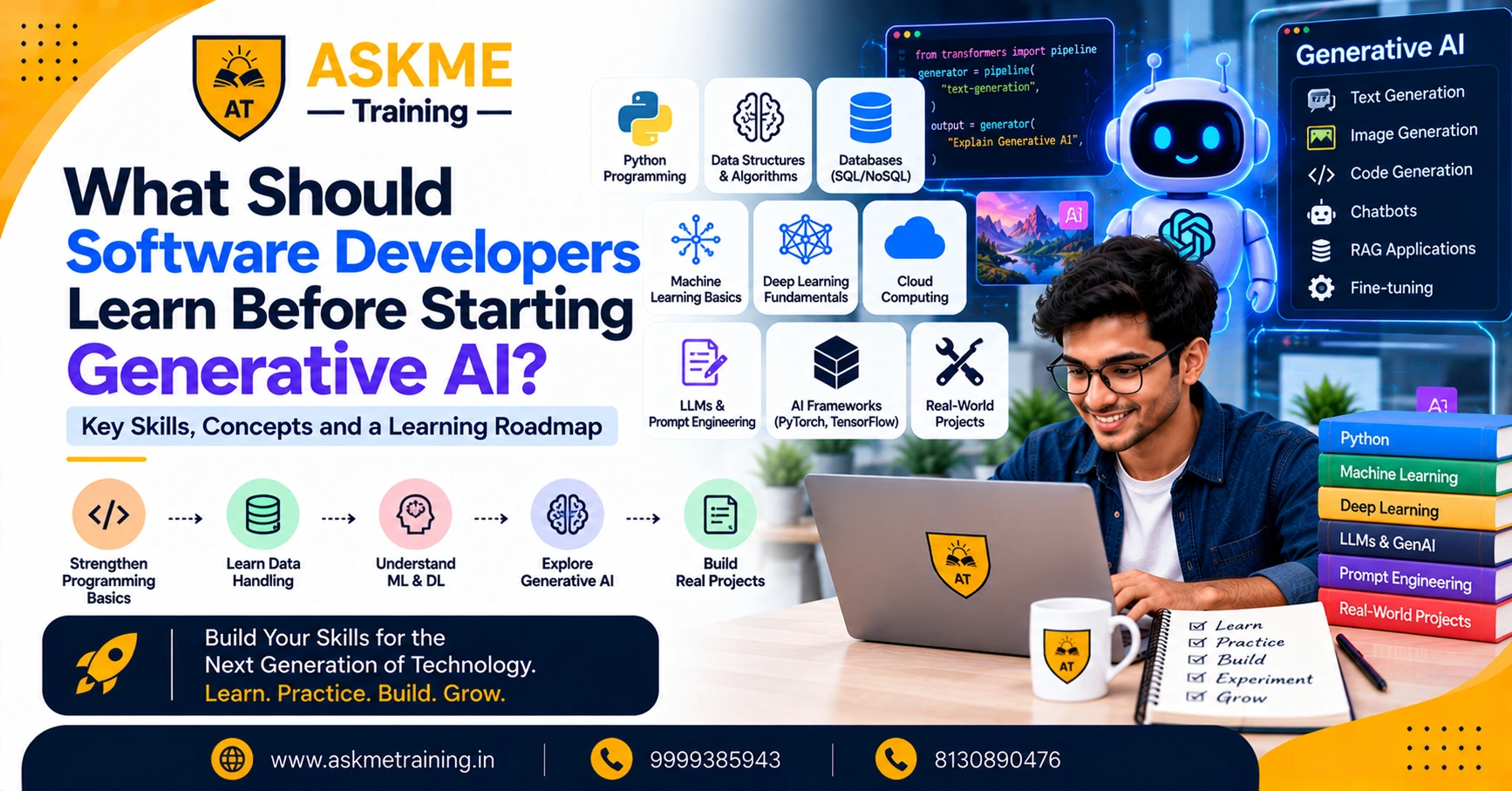
7 Essential Skills to Learn Before Starting Generative AI
1. Programming Fundamentals
Python is a popular language for Generative AI because it offers many useful libraries and development tools. However, developers familiar with JavaScript, Java, or other languages can also build AI-powered applications.
Start with variables, functions, loops, object-oriented programming, error handling, and JSON data.
Practical example: Write a Python program that accepts a question and sends it to an AI model through an API.
2. APIs and Backend Development
APIs allow applications to communicate with AI models. Understanding HTTP requests, REST APIs, authentication, and error handling helps you integrate AI features into websites and software products.
For example, you could connect an AI model to a website to answer common customer questions.
3. Basic Machine Learning Concepts
You do not need advanced mathematics to build your first AI application. However, understanding machine learning fundamentals helps you make better technical decisions.
Learn about training, inference, model limitations, and how AI systems identify patterns in data. This knowledge helps you understand why AI sometimes generates incorrect answers.
4. Prompt Engineering
Prompt engineering means writing clear instructions to guide an AI model toward a useful response.
Instead of asking, “Fix my code,” provide the programming language, error message, relevant code, and expected result.
Practise writing structured prompts, giving examples, defining output formats, and testing different instructions.
5. Data, Embeddings, and Vector Databases
AI applications often need information from documents, databases, or company resources.
Embeddings represent information as numerical vectors, helping applications identify related content. Vector databases store and retrieve these representations efficiently.
Understanding data preparation, document chunking, and similarity search will help you build more useful AI applications.
6. Large Language Models and RAG
Large language models generate responses based on user instructions and the context they receive.
Retrieval-augmented generation (RAG) allows an application to retrieve relevant information from external documents before generating an answer.
For example, you could build a chatbot that answers questions using course materials instead of relying only on general model knowledge. Remember that RAG improves access to relevant information but does not guarantee completely accurate answers.
7. Testing, Security, and Deployment
A working demonstration is not the same as a reliable application. Developers must test AI responses, validate inputs, protect API keys, and monitor performance.
Learn the basics of privacy, access control, response quality, deployment, and operating costs before making an application available to users.
How to Start Learning Generative AI Step by Step
Follow this beginner-friendly roadmap:
1. Strengthen programming skills: Practise Python or your preferred programming language.
2. Learn API integration: Build a small application that sends requests and processes responses.
3. Explore LLMs and prompts: Experiment with instructions and different model outputs.
4. Build your first project: Create a text summarizer, FAQ assistant, or code explainer.
5. Learn RAG: Connect your application to a collection of relevant documents.
6. Test and deploy: Check accuracy, security, and performance before sharing your application.
A generative AI course with real-world projects can help you practise these steps in a structured way. Look for practical assignments, instructor guidance, code reviews, and deployment exercises.
Benefits of Generative AI Training for Software Developers in India
Practical training can help developers connect theoretical knowledge with application development.
Important benefits include:
• Hands-on experience with AI development tools.
• Better understanding of LLMs, APIs, and RAG.
• Portfolio projects to demonstrate technical skills.
• Experience solving realistic business problems.
• Structured learning with guidance and feedback.
When selecting a course, review its syllabus and confirm that the projects cover practical development rather than theory alone.
Career Opportunities After Learning Generative AI
Generative AI skills can complement your existing software development experience. Depending on your technical background, you may explore roles such as:
• AI application developer
• Generative AI engineer
• LLM application developer
• AI software engineer
• RAG application developer
Employers may also expect knowledge of cloud platforms, databases, software architecture, or machine learning. Completing a course does not guarantee a job, so focus on developing demonstrable skills and a strong project portfolio.
Common Mistakes and Expert Tips
Avoid these common mistakes:
• Skipping programming fundamentals.
• Depending entirely on prompts without testing outputs.
• Exposing API keys or mishandling sensitive data.
• Learning too many frameworks simultaneously.
• Building projects without checking accuracy and performance.
Expert tip: Start with one useful project, such as a document-based chatbot. Document how it works, test its limitations, keep your code organised, and explain your design decisions. A well-documented project can help demonstrate your abilities during technical interviews.
Frequently Asked Questions
1. Can developers learn Generative AI without machine learning experience?
Yes. Start with programming, APIs, and LLM integration, then learn machine learning concepts as needed.
2. Is Python necessary for Generative AI?
Python is popular, but JavaScript and TypeScript are also useful for developing AI-powered applications.
3. Do I need to train my own AI model?
No. Beginners can build useful applications by connecting existing models through APIs.
4. Which projects should beginners build?
Start with a chatbot, document summarizer, code explanation tool, or RAG-based question-answering application.
5. How do I choose a Generative AI course?
Look for programming fundamentals, API integration, LLMs, prompt engineering, RAG, testing, and hands-on projects.
Start Your Generative AI Journey with Askme Training Institute
Generative AI gives software developers new ways to build applications, automate tasks, and solve business problems. The best starting point is to strengthen your fundamentals and practise by building real projects.
Askme Training Institute can help you explore training opportunities aligned with your learning goals. Visit https://www.askmetraining.in/ to explore available programs and discuss the curriculum, practical projects, and instructor support before enrolling.
Take the first step towards developing practical Generative AI skills and expanding your software development capabilities.
