

 Askme Training
Data Science and AI in 2026: What Should Beginners Learn First?
- By Admin
- Posted on 05/10/2026
Data science and artificial intelligence are no longer futuristic. They are used by industries in 2026 for information analysis, work automation, trend prediction, customer experience enhancement, and business decision support.
However, this presents a new problem for a novice: Which should I learn first, Python, Data Science, Machine Learning, or AI?
The solution is straightforward: start with building your foundation before moving on to more sophisticated AI. Selecting a planned learning route can help you avoid confusion and acquire useful, employable skills if you are searching for the Best Data Science Training Institute in Noida.
Why Should Beginners Learn Data Science and AI in 2026?
Businesses generate enormous amounts of data every day. They need professionals who can turn that data into useful insights and intelligent solutions.
At the same time, Generative AI, Machine Learning, and automation are changing traditional job roles. This means beginners who understand data + programming + AI fundamentals can prepare themselves for a wide range of technology careers.
However, trying to learn everything at once is one of the biggest mistakes beginners make.
What Should You Learn First?
A practical Data Science and AI roadmap should follow a logical sequence.
1. Learn Python Fundamentals
Python is one of the most widely used programming languages for Data Science and AI.
Start with:
• Variables and data types
• Conditions and loops
• Functions
• Lists and dictionaries
• File handling
• Basic object-oriented programming
You do not need to become an expert programmer initially. Your goal is to become comfortable writing and understanding Python code.
2. Understand Statistics
Statistics helps you understand data and interpret results correctly.
Focus on beginner-friendly concepts such as:
• Mean, median, and mode
• Probability
• Percentages
• Standard deviation
• Correlation
• Data distributions
For example, if an online store wants to understand customer purchasing behavior, statistics can help identify meaningful patterns instead of relying on assumptions.
3. Learn SQL and Data Handling
Real-world Data Science involves working with databases. This makes SQL an important skill.
Beginners should understand:
• SELECT and WHERE
• GROUP BY and ORDER BY
• JOIN
• Aggregate functions
• Filtering and sorting data
You should also learn how to clean missing, duplicate, or inconsistent data before analyzing it.
4. Master Data Analysis and Visualization
Now it is time to work with actual datasets.
Tools such as NumPy, Pandas, Matplotlib, Excel, and Power BI can help you analyze and visualize information.
For example, instead of simply looking at thousands of sales records, you could create a dashboard showing monthly sales, best-performing products, customer trends, and revenue patterns.
This is where theoretical learning starts becoming practical.
When Should You Start Machine Learning?
Once you understand Python, statistics, SQL, and data analysis, you can begin Machine Learning.
Start with fundamental algorithms such as:
1. Linear Regression
2. Logistic Regression
3. Decision Trees
4. Random Forest
5. K-Nearest Neighbors
6. Clustering
Do not focus only on memorizing algorithms. Understand what problem an algorithm solves, when to use it, and how to evaluate the result.
When Should Beginners Learn AI and Generative AI?
After developing your Data Science and Machine Learning foundation, you can explore modern AI technologies.
Depending on your career goals, you can move into:
• Deep Learning
• Natural Language Processing
• Computer Vision
• Generative AI
• Large Language Models
• Prompt Engineering
• Retrieval-Augmented Generation (RAG)
This approach is much more effective than starting directly with advanced AI tools without understanding the fundamentals behind them.
A Simple Data Science and AI Roadmap
If you are asking “What should I learn first in Data Science and AI?”,
follow this sequence:
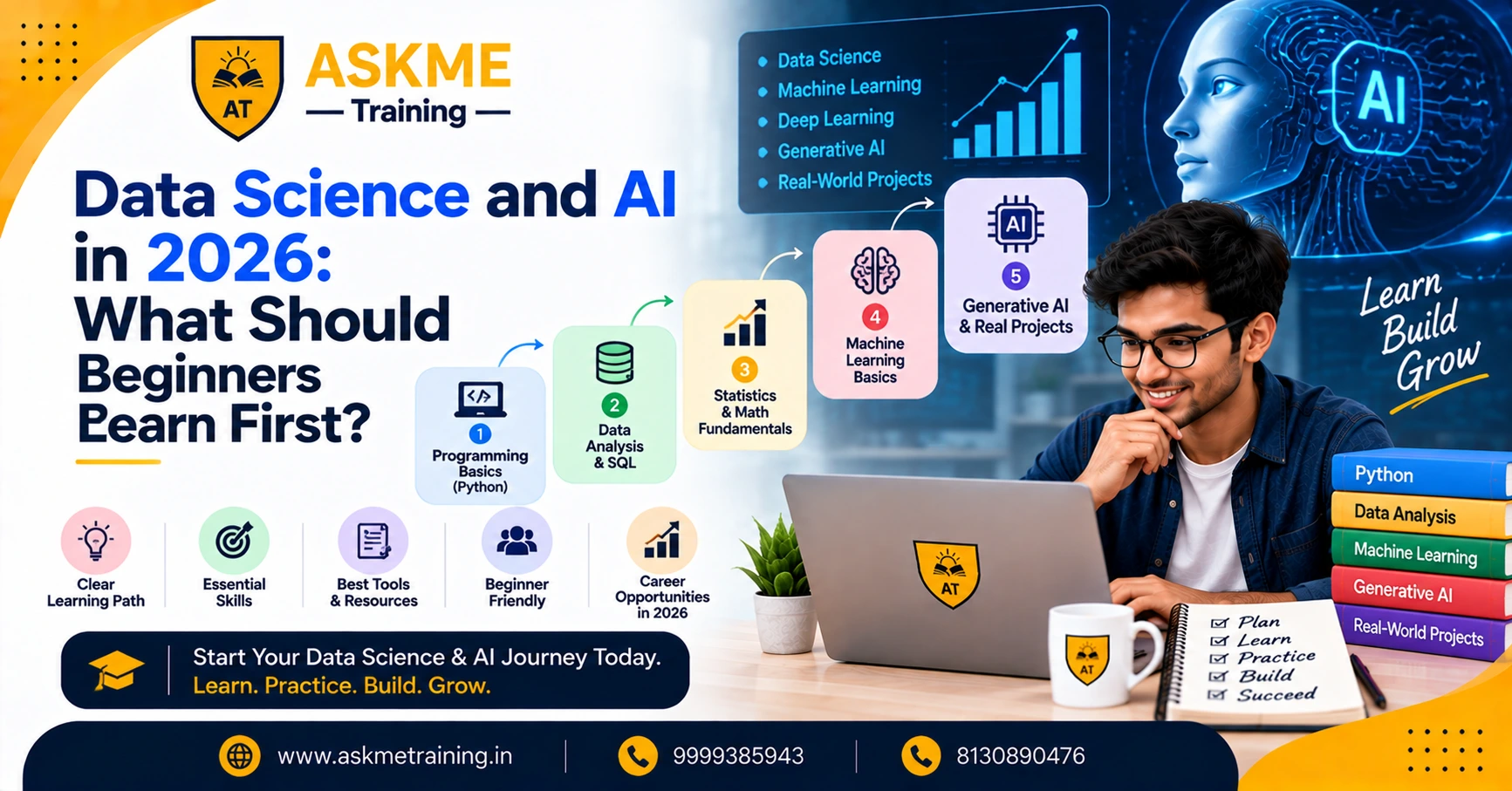
Python → Statistics → SQL → Data Analysis → Visualization → Machine Learning → Deep Learning → Generative AI
If you prefer flexible learning, online data science training in Noida with certification can provide a structured way to follow this roadmap while balancing college, work, or other commitments.
What Projects Should Beginners Build?
Projects are essential because employers want to see how you apply your knowledge.
Start with practical projects such as:
• Sales Data Analysis
• House Price Prediction
• Customer Churn Prediction
• Customer Segmentation
• Movie Recommendation System
• Sentiment Analysis
• AI Chatbot
For every project, explain the problem, dataset, technology used, approach, and outcome. This turns a simple project into evidence of your practical skills.
Career Opportunities in Data Science and AI
A strong foundation can help beginners explore roles such as:
• Data Analyst
• Junior Data Scientist
• Machine Learning Engineer
• AI Engineer
• Business Analyst
• Data Engineer
• Generative AI Developer
Your career path will depend on your skills, educational background, projects, experience, and specialization.
Common Mistakes Beginners Should Avoid
Starting with advanced AI: Learn the basics before jumping into complex models.
Learning without practice: Watching tutorials is not enough. Build projects regularly.
Trying to learn every tool: Focus on essential skills instead of chasing every new AI platform.
Ignoring communication: Data professionals must explain technical findings clearly to business teams.
Expert Tips for Beginners in 2026
Follow these simple principles:
• Build strong fundamentals first.
• Practice Python consistently.
• Work with real datasets.
• Create projects while learning.
• Document your projects in a portfolio.
• Practice technical interview questions.
• Keep updating your knowledge as AI evolves.
Most importantly, do not try to master everything in one month. Consistency and practical experience matter more than rushing through a long list of technologies.
FAQs
Is Data Science difficult for beginners?
It can feel challenging initially, but learning Python, statistics, SQL, and data analysis step by step makes the journey easier.
Can I learn Data Science without a programming background?
Yes. Beginners can start with basic Python and gradually develop programming skills alongside Data Science concepts.
Is Python necessary for Data Science?
Python is highly recommended because of its extensive libraries and widespread use in Data Science, Machine Learning, and AI.
Should I learn AI before Machine Learning?
For most beginners, it is better to understand Data Science and Machine Learning fundamentals before moving into advanced AI.
Is Data Science a good career choice in 2026?
Yes. Data-driven decision-making and AI adoption continue to create opportunities across technology, finance, healthcare, retail, marketing, and other industries.
Start Your Data Science and AI Journey
The right roadmap can make your Data Science and AI journey much clearer. If you are searching for the Best Data Science Training Institute in Noida, Askme Training Institute can help you build practical skills through structured training, hands-on projects, expert guidance, and career-focused learning.
Whether you are a student, fresher, or working professional, start with the fundamentals and gradually build toward advanced AI.
Ready to begin? Explore Data Science and AI training at Askme Training Institute and take the next step toward your technology career.
