
 Askme Training
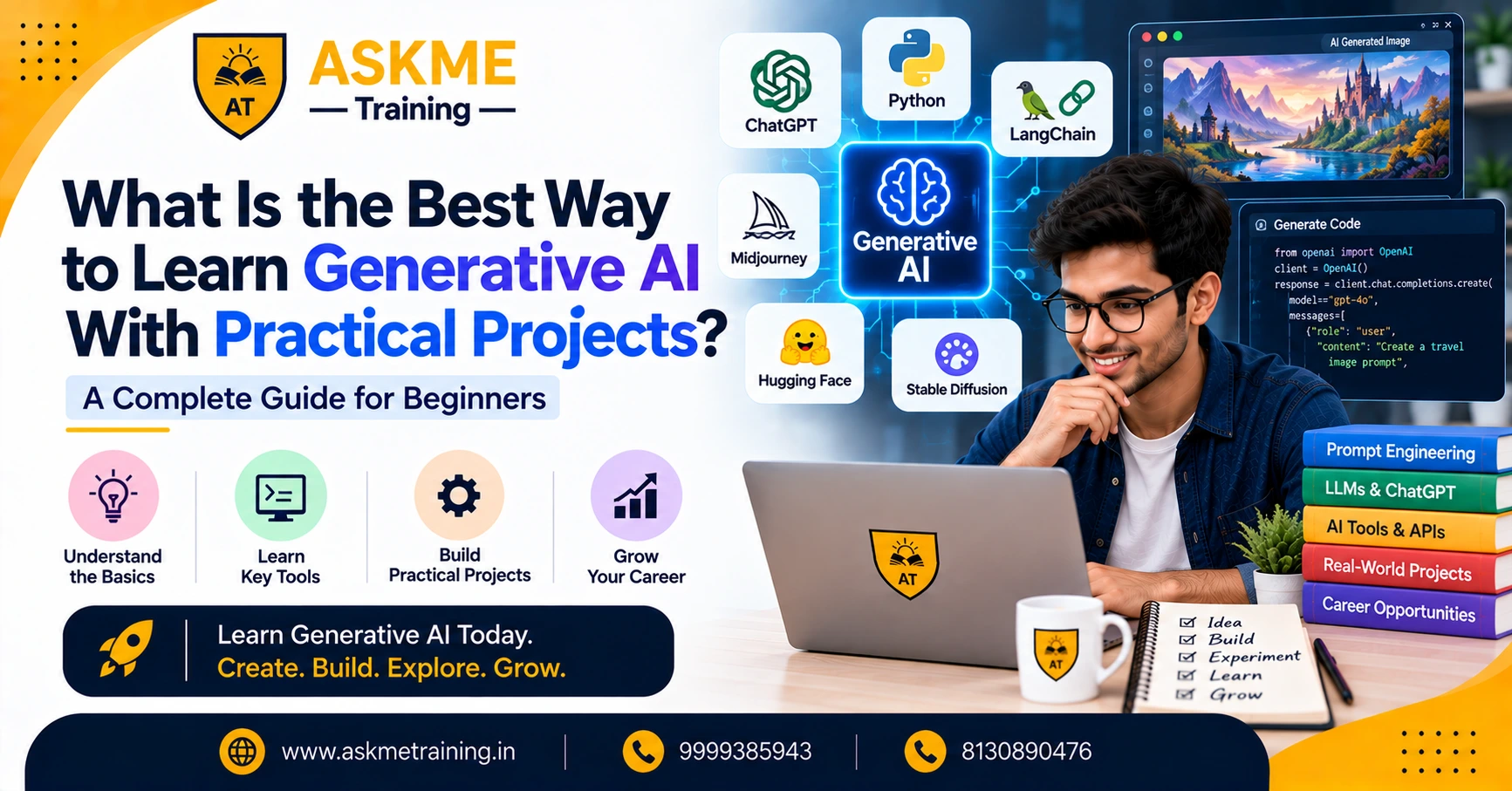
What Is the Best Way to Learn Generative AI With Practical Projects?
- By Admin
- Posted on 30/09/2026
Generative AI is changing how people create content, write code, analyze information, automate tasks, and build digital products. But there is a big difference between watching Generative AI tutorials and actually knowing how to use AI to solve real problems.
For beginners, one of the most effective ways to learn is through a Generative AI Course With Real-World Projects. Instead of only studying concepts, you learn by building practical applications, experimenting with AI tools, solving problems, and creating projects that demonstrate your skills.
If you are a student, fresher, software developer, or working professional, project-based learning can make your Generative AI journey more practical and career-focused.
Why Learn Generative AI Through Practical Projects?
Imagine learning Python by watching 50 hours of videos without writing a single program. You may understand the theory, but when someone asks you to build an application, you may not know where to start. Generative AI works similarly.
Practical projects help you understand:
• How AI models are used in real applications
• How to write effective prompts
• How to work with APIs and AI tools
• How to integrate AI into software applications
• How to identify and solve real-world problems
• How to test and improve AI-generated results
• How to explain your work during interviews
This is why a generative AI course with real-world projects can be more valuable than learning AI concepts in isolation.
What Should You Learn in a Generative AI Course?
A good course should take you from fundamentals to practical implementation.
1. Generative AI Fundamentals
Start with the basics:
• What is Generative AI?
• How do Large Language Models work?
• What are ChatGPT-style AI systems?
• What are tokens, prompts, context, and embeddings?
• How are AI models different from traditional software?
You do not need to become an AI researcher to start. A strong foundation simply helps you understand what happens behind the tools you use.
2. Prompt Engineering
Prompting is an important practical skill.
You can learn how to create prompts for:
• Content generation
• Summarization
• Data extraction
• Coding assistance
• Research
• Customer support
• Business workflows
For example, instead of asking an AI tool to “write a test case,” you can provide the application context, user story, expected format, testing conditions, and output requirements. The result becomes much more useful.
3. Build Real-World Projects
This is where learning becomes interesting.
A project-based Generative AI program could include applications such as:
AI Chatbot: Build a chatbot that answers questions using a defined knowledge base.
AI Resume Assistant: Create a tool that analyzes a resume and suggests improvements based on a job description.
AI Coding Assistant: Develop a small application that generates or explains code based on user instructions.
Document Q&A Application: Build an application that allows users to ask questions about uploaded documents.
AI Testing Assistant: Explore how Generative AI can help generate test scenarios, test cases, bug descriptions, or automation code.
These projects give learners something concrete to demonstrate when discussing their skills with recruiters or employers.
Step-by-Step Guide to Learning Generative AI
If you are starting from scratch, follow this simple roadmap:
1. Understand AI fundamentals
Learn basic AI and Generative AI concepts.
2. Learn prompt engineering
Practice writing clear, structured prompts.
3. Understand APIs and AI tools
Learn how applications communicate with AI models.
4. Learn relevant programming basics
Python can be particularly useful for building AI applications.
5. Build small projects
Start with simple applications before moving to complex systems.
6. Work on real-world problems
Build projects that solve practical business or user problems.
7. Create a portfolio
Document your projects, technologies, challenges, and results.
8. Practice explaining your projects
Be ready to explain what you built, why you built it, and how it works.
Benefits of Generative AI Training for Software Developers in India
For software developers, Generative AI can complement existing development skills rather than completely replacing them.
Generative AI Training For Software Developers in India can help learners explore areas such as:
• AI-assisted software development
• Code generation and code review
• Test-case generation
• Documentation automation
• AI-powered applications
• API integration
• Retrieval-Augmented Generation (RAG)
• AI agents and automation
• Developer productivity
For example, a software tester could explore an AI-powered test-case generator, while a full-stack developer could build a chatbot or document-analysis application.
The key is to combine your existing technical knowledge with Generative AI capabilities.
Career Opportunities After Learning Generative AI
Generative AI skills can complement several technology roles, including:
• Generative AI Developer
• AI Application Developer
• AI Automation Developer
• Prompt Engineer
• AI/ML Engineer
• Software Developer with AI skills
• AI Solutions Developer
• AI-focused QA/Test Automation Professional
Your career path will depend on your existing skills, programming knowledge, experience, and the depth of AI expertise you develop.
Common Mistakes Beginners Should Avoid
Learning Generative AI can become confusing when you try to learn everything simultaneously.
Avoid these common mistakes:
• Learning only theory without building projects
• Collecting AI tools without understanding fundamentals
• Copying projects without understanding the code
• Ignoring programming and API basics
• Building projects without documenting them
• Depending completely on AI-generated code
• Focusing only on certificates instead of practical skills
The goal should not simply be to say, “I completed an AI course.” The goal should be to confidently say, “I can build something useful with Generative AI.”
Expert Tips for Learning Generative AI Faster
Start small and stay consistent.
Choose one practical problem and try to solve it using Generative AI. When you face an error, investigate it. When the AI gives you incorrect output, understand why. When your application works, improve it.
Also maintain a project portfolio containing:
• Project objective
• Technologies used
• Problem solved
• Key features
• Challenges faced
• Screenshots or demonstrations
• GitHub/project link
• What you learned
This makes your learning journey easier to demonstrate during interviews.
FAQs About Learning Generative AI With Projects
1. What is the best way to learn Generative AI?
The best approach is to combine fundamental concepts, hands-on practice, prompt engineering, programming, and real-world projects rather than relying only on theoretical learning.
2. Can beginners learn Generative AI?
Yes. Beginners can start with Generative AI fundamentals and gradually learn prompting, APIs, programming, and project development.
3. Do I need coding skills to learn Generative AI?
Not necessarily for basic AI tool usage and prompting. However, programming knowledge—especially Python—can be valuable when building advanced AI applications.
4. Why are real-world projects important in Generative AI training?
Projects allow learners to apply concepts, understand practical challenges, create portfolios, and develop problem-solving skills.
5. Is Generative AI useful for software developers?
Yes. Developers can use Generative AI for coding assistance, documentation, testing, automation, application development, and productivity workflows.
6. How long does it take to learn Generative AI?
The time varies depending on your background and learning goals. Learning fundamentals may take weeks, while becoming comfortable building advanced applications requires continued practice.
7. What projects can I build while learning Generative AI?
You can build AI chatbots, document Q&A applications, resume assistants, coding assistants, AI testing tools, content automation systems, and other AI-powered applications.
Start Your Generative AI Learning Journey With Askme Training Institute
Learning Generative AI becomes much easier when you move beyond theory and start building.
At Askme Training Institute, learners can explore Generative AI concepts through practical learning, industry-focused skills, and project-based development.
Whether you are a student, fresher, software developer, tester, or working professional, practical Generative AI training can help you understand how AI can be applied to real-world technology and business problems.
Ready to turn your AI knowledge into practical skills?
Explore Generative AI training with Askme Training Institute, book a demo, and start building your own AI projects.
Visit: https://www.askmetraining.in/
