
 Askme Training
How Can I Start Learning Full Stack Development from Scratch?
- By Admin
- Posted on 28/09/2026
Starting a career in web development can feel confusing, especially when you see technologies like HTML, JavaScript, React, Node.js, MongoDB, and APIs everywhere. The good news is that you don't need to master everything at once.
If you are a beginner, the best approach is to follow a structured roadmap, practice consistently, and build real projects. A Job oriented full stack development diploma can help you learn these skills step by step while preparing for real-world development and career opportunities.
What Is Full Stack Development?
Full stack development means building both the frontend and backend of a web application.
The frontend is what users see and interact with, such as web pages, forms, buttons, and dashboards. The backend manages application logic, databases, authentication, APIs, and server-side operations.
A full stack developer may work with:
• HTML and CSS
• JavaScript
• React.js
• Node.js
• Express.js
• MongoDB
• REST APIs
• Git and GitHub
Why Learn Full Stack Development?
Consider a fresher who knows basic computers but has never programmed before. Instead of trying to learn multiple technologies simultaneously, they can start with HTML and CSS, move to JavaScript, and gradually learn frontend and backend development.
This step-by-step approach makes learning easier and more practical.
Full stack development can help you build:
• Programming and problem-solving skills
• Frontend and backend knowledge
• Database skills
• API development experience
• Real-world projects
• A professional portfolio
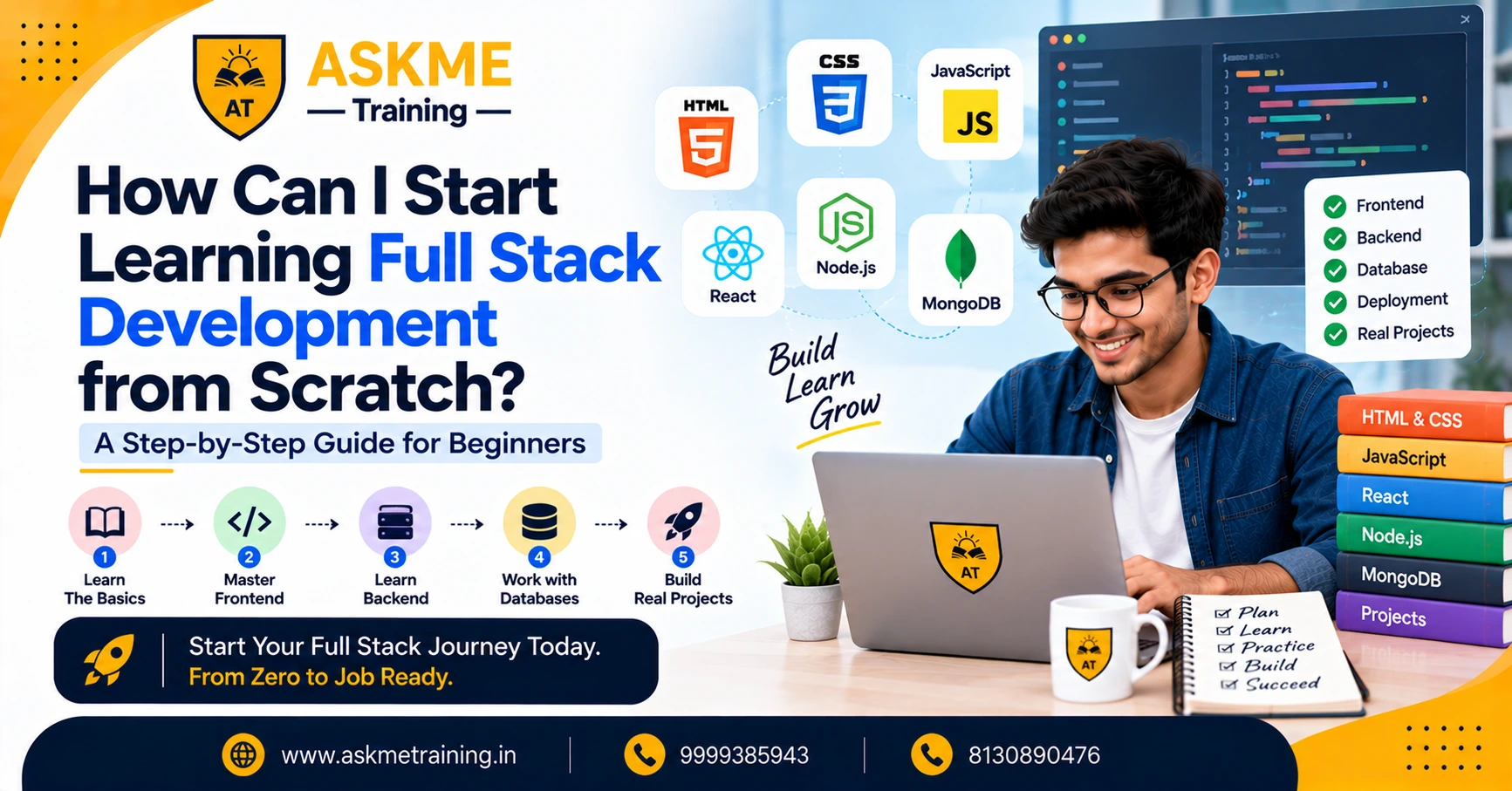
How Can I Start Learning Full Stack Development from Scratch?
1. Start with HTML and CSS
HTML creates the structure of a webpage, while CSS controls its design and layout.
Start by building simple projects such as a personal portfolio, registration form, or basic business website. These projects help you understand how websites are structured.
2. Learn JavaScript
After HTML and CSS, learn JavaScript. It adds functionality and interactivity to websites.
Important concepts include:
• Variables and data types
• Functions
• Arrays and objects
• Loops
• DOM manipulation
• Events
• ES6 features
• Asynchronous JavaScript
Don't just watch tutorials. Write code and solve small problems regularly.
3. Learn React.js
Once your JavaScript fundamentals are strong, move to React.js.
React helps developers create modern, reusable user interfaces. You can practice by building applications such as a task manager, weather application, or product dashboard.
4. Learn Backend Development
Next, understand what happens behind the website.
Node.js and Express.js can be used to create backend applications and APIs. Learn concepts such as:
• Server-side programming
• REST APIs
• Authentication
• CRUD operations
• Error handling
• API integration
At this stage, you can connect your frontend with your backend.
5. Learn MongoDB and Databases
Applications need databases to store information such as users, products, orders, and messages.
MongoDB is commonly used with the MERN stack. Learn how to create, retrieve, update, and delete data and connect your database with backend applications.
6. Build Real-World Projects
Projects are one of the most important parts of learning full stack development.
Start with smaller applications and gradually build more advanced projects such as:
• E-commerce website
• Job portal
• Student management system
• Expense tracker
• Blog application
• Online booking platform
Projects help demonstrate that you can apply your knowledge instead of simply completing tutorials.
What Is a Diploma in Full Stack Development with MERN Stack?
A diploma in full stack development with MERN stack generally focuses on MongoDB, Express.js, React.js, and Node.js.
For beginners, structured training can make the learning journey easier because you have a defined curriculum instead of having to decide what to learn next.
Before choosing a program, check whether it includes:
• Practical coding
• Real-world projects
• Frontend and backend development
• Database training
• API development
• Git and GitHub
• Portfolio building
• Interview preparation
• Career or placement assistance
Benefits of a Job Oriented Full Stack Development Diploma
A job-oriented program focuses on practical application rather than theory alone.
Potential benefits include:
• Structured learning
• Hands-on practice
• Industry-relevant technologies
• Project experience
• Portfolio development
• Interview preparation
• Trainer guidance
However, your career growth will ultimately depend on how well you understand the concepts and apply them through projects and problem-solving.
Career Opportunities After Full Stack Development Training
After developing the required skills and practical experience, learners can explore roles such as:
• Full Stack Developer
• Frontend Developer
• React Developer
• Backend Developer
• Node.js Developer
• Web Developer
• Junior Software Developer
Your opportunities will depend on your skills, portfolio, experience, communication abilities, and individual employer requirements.
Common Mistakes Beginners Should Avoid
Avoid these common mistakes:
Learning too many technologies at once: Follow a logical sequence.
Only watching tutorials: Practice coding yourself.
Ignoring projects: Build applications regularly.
Copying code without understanding it: Learn what every important section does.
Avoiding debugging: Debugging is a normal part of development.
Relying only on certificates: Practical skills and projects matter.
Expert Tips for Beginners
To make consistent progress:
1. Practice coding every day.
2. Build a project after learning each major technology.
3. Upload projects to GitHub.
4. Learn to read technical documentation.
5. Understand how frontend, backend, APIs, and databases connect.
6. Practice explaining your projects before interviews.
7. Keep improving your portfolio.
Frequently Asked Questions
Can I learn full stack development from scratch?
Yes. Beginners can start with HTML and CSS, learn JavaScript, and then progress to React, backend development, databases, APIs, and projects.
Is full stack development difficult for beginners?
It can seem challenging initially, but following a structured roadmap and practicing consistently can make the learning process easier.
What is the MERN stack?
MERN stands for MongoDB, Express.js, React.js, and Node.js. These technologies can work together to build modern web applications.
Is a full stack diploma useful for freshers?
A structured diploma can provide guided learning, practical projects, and interview preparation. The value depends on the quality of training and the skills you develop.
Do I need a computer science degree?
Not necessarily. Beginners from different educational backgrounds can learn full stack development if they are willing to practice programming and build practical skills.
What projects should beginners build?
Start with simple projects such as portfolios and task managers, then progress to e-commerce websites, booking systems, job portals, and management applications.
Start Your Full Stack Development Journey with Askme Training Institute
Learning full stack development becomes easier when you have a clear roadmap, practical training, and project-based learning.
If you are a student, fresher, working professional, or career switcher, explore the Job oriented full stack development diploma at Askme Training Institute.
Build practical skills, work on projects, strengthen your portfolio, and prepare for your next career opportunity.
Ready to begin your journey?
Visit https://www.askmetraining.in/ or contact Askme Training Institute to explore the course and discuss your learning goals.
