
 Askme Training
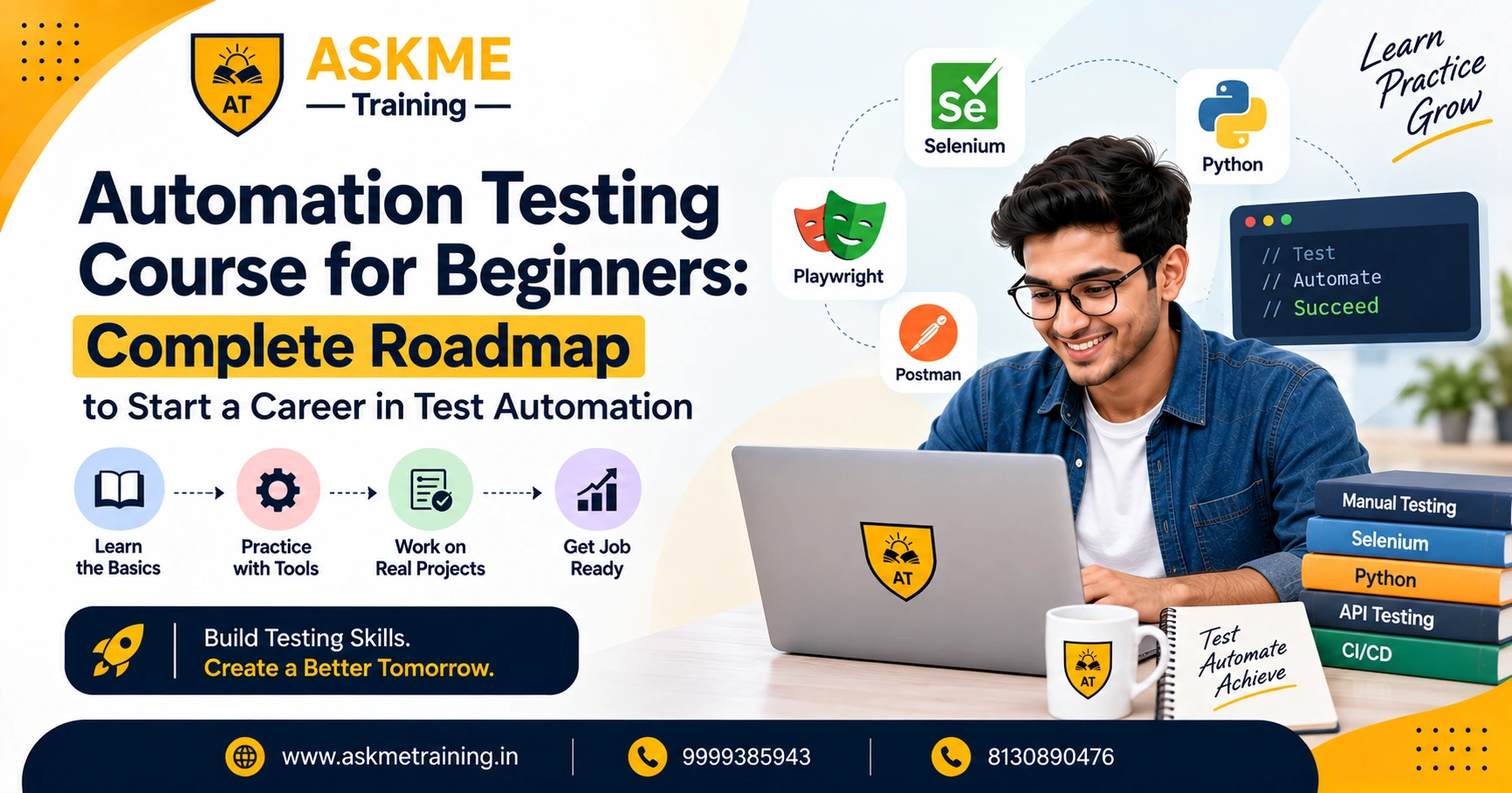
Automation Testing Course for Beginners: Complete Roadmap to Start a Career in Test Automation
- By Admin
- Posted on 04/09/2026
Imagine you are a fresher applying for your first QA job. You understand manual testing, test cases, and bug reporting, but then you see job descriptions asking for Selenium, Java, automation frameworks, API testing, Git, and CI/CD.
Suddenly, software testing feels much bigger than expected.
This is where a structured Automation Testing Course for Beginners can make a difference. Instead of trying to learn every tool randomly, you can follow a step-by-step path that takes you from testing fundamentals to practical test automation.
What Is Automation Testing?
Automation testing is the process of using software tools and scripts to perform predefined test cases automatically.
Consider an online shopping website. Every time a new version is released, testers may need to check login, product search, shopping cart, checkout, and other frequently used functions.
The goal is to use automation where it adds value.
Why Should Beginners Learn Automation Testing?
Software applications are released and updated more frequently than ever. As development cycles become faster, organizations need efficient software quality assurance processes.
Learning test automation can help you develop skills in:
• Automated regression testing
• Test case execution
• Programming and debugging
• Selenium WebDriver
• Automation frameworks
• API testing
• Version control
• Continuous integration
• Software quality assurance
For beginners, automation can also be a valuable way to combine testing knowledge with technical and programming skills.
What Should You Learn in an Automation Testing Course for Beginners?
A common mistake beginners make is starting with a tool without understanding the testing process. A better approach is to build your knowledge gradually.
1. Start With Software Testing Fundamentals
Before writing automation scripts, learn how software is tested.
Important topics include:
• Software Development Life Cycle (SDLC)
• Software Testing Life Cycle (STLC)
• Test scenarios and test cases
• Functional testing
• Non-functional testing
• Regression testing
• Smoke and sanity testing
• Defect life cycle
• Agile testing
For example, if you don't understand what regression testing means, it becomes difficult to decide which regression test cases should be automated.
2. Learn Programming Basics
You don't need to become a professional developer before starting automation. However, basic programming knowledge is essential.
Learn concepts such as:
• Variables and data types
• Operators
• Conditions
• Loops
• Functions and methods
• Classes and objects
• Exception handling
• Object-oriented programming
Java, Python, and JavaScript are commonly used in different test automation environments.
3. Learn Selenium WebDriver
Selenium is an important technology for web application automation.
An Automation Selenium Testing Course can introduce beginners to Selenium WebDriver and concepts such as:
• Locators
• Web elements
• Browser commands
• Waits
• Alerts
• Frames
• Multiple windows
• Dropdowns
• Form interactions
This is where theoretical knowledge starts becoming practical.
4. Understand Automation Testing Frameworks
Writing a few Selenium scripts is only the beginning. Real projects require automation code that is organized, reusable, and easy to maintain.
Beginners should gradually understand:
• Page Object Model
• TestNG
• Maven
• Data-driven testing
• Reusable methods
• Test reports
• Configuration management
• Parallel test execution
Framework knowledge helps you move from simply writing scripts to understanding how professional automation projects are structured.
5. Learn API Testing and Supporting Tools
Modern QA work isn't limited to testing the user interface.
Once you understand UI automation, consider learning:
• REST APIs
• HTTP methods
• JSON
• Postman
• API validation
• Git and GitHub
• Jenkins
• CI/CD fundamentals
These technologies help you understand the complete testing workflow and how automated tests can be integrated into software delivery pipelines.
Automation Testing Roadmap for Beginners
If you're asking, “How do I start automation testing as a beginner?”, follow this simple roadmap:
Step 1: Learn software testing fundamentals
Step 2: Understand manual testing concepts
Step 3: Learn programming basics
Step 4: Start Selenium WebDriver
Step 5: Practice real-world test cases
Step 6: Learn TestNG and Maven
Step 7: Understand Page Object Model
Step 8: Build an automation testing project
Step 9: Learn API testing, Git, and CI/CD
Step 10: Prepare for automation testing interviews
Don't rush through these steps. The objective isn't to finish ten technologies quickly; it is to understand how they work together.
Career Opportunities in Automation Testing
After developing relevant skills and practical experience, learners can explore roles such as:
• QA Engineer
• Automation Test Engineer
• Software Test Engineer
• QA Automation Engineer
• SDET
• Test Automation Developer
Your career path will depend on your technical skills, project experience, communication abilities, interview performance, and the requirements of individual organizations.
Common Mistakes Beginners Should Avoid
Trying to learn everything together: Focus on one stage at a time.
Ignoring testing fundamentals: Good automation starts with good test design.
Only watching tutorials: Write your own scripts and troubleshoot errors.
Learning Selenium without programming: Basic coding knowledge makes automation much easier to understand.
Skipping projects: Practice realistic workflows such as login, search, checkout, and form validation.
Focusing only on UI automation: Gradually add API testing, Git, and CI/CD to your skill set.
Expert Tips for Learning Automation Testing
If you want to learn automation effectively:
1. Practice coding regularly.
2. Automate simple scenarios first.
3. Understand errors instead of simply copying solutions.
4. Write clean and reusable test scripts.
5. Build at least one meaningful automation project.
6. Practice explaining your framework during interviews.
7. Follow current QA and automation trends.
8. Focus on problem-solving rather than memorizing commands.
Frequently Asked Questions
Is automation testing suitable for beginners?
Yes. Beginners can learn automation by starting with software testing fundamentals, basic programming, and gradually moving toward Selenium and automation frameworks.
Can I learn automation testing without coding experience?
Yes, but basic programming knowledge is strongly recommended. Coding makes it easier to create, understand, debug, and maintain automation scripts.
Which programming language should beginners learn?
Java, Python, and JavaScript are widely used. Your choice should depend on your career goals and the technology stack commonly used in your target roles.
What jobs can I get after learning automation testing?
Potential roles include QA Engineer, Automation Test Engineer, Software Test Engineer, QA Automation Engineer, and SDET, depending on your skills and experience.
Start Your Automation Testing Journey With Askme Training Institute
Learning automation is easier with a clear roadmap, practical exercises, and guidance from experienced trainers.
At Askme Training Institute, students, freshers, and professionals can explore structured learning opportunities to develop software testing and automation skills.
Instead of trying to learn everything at once, build your foundation, practice Selenium, understand automation frameworks, work on practical projects, and gradually expand into API testing and CI/CD.
Ready to take the next step? Visit Askme Training Institute to explore available training options or connect with the team about your automation testing learning goals.
