
 Askme Training
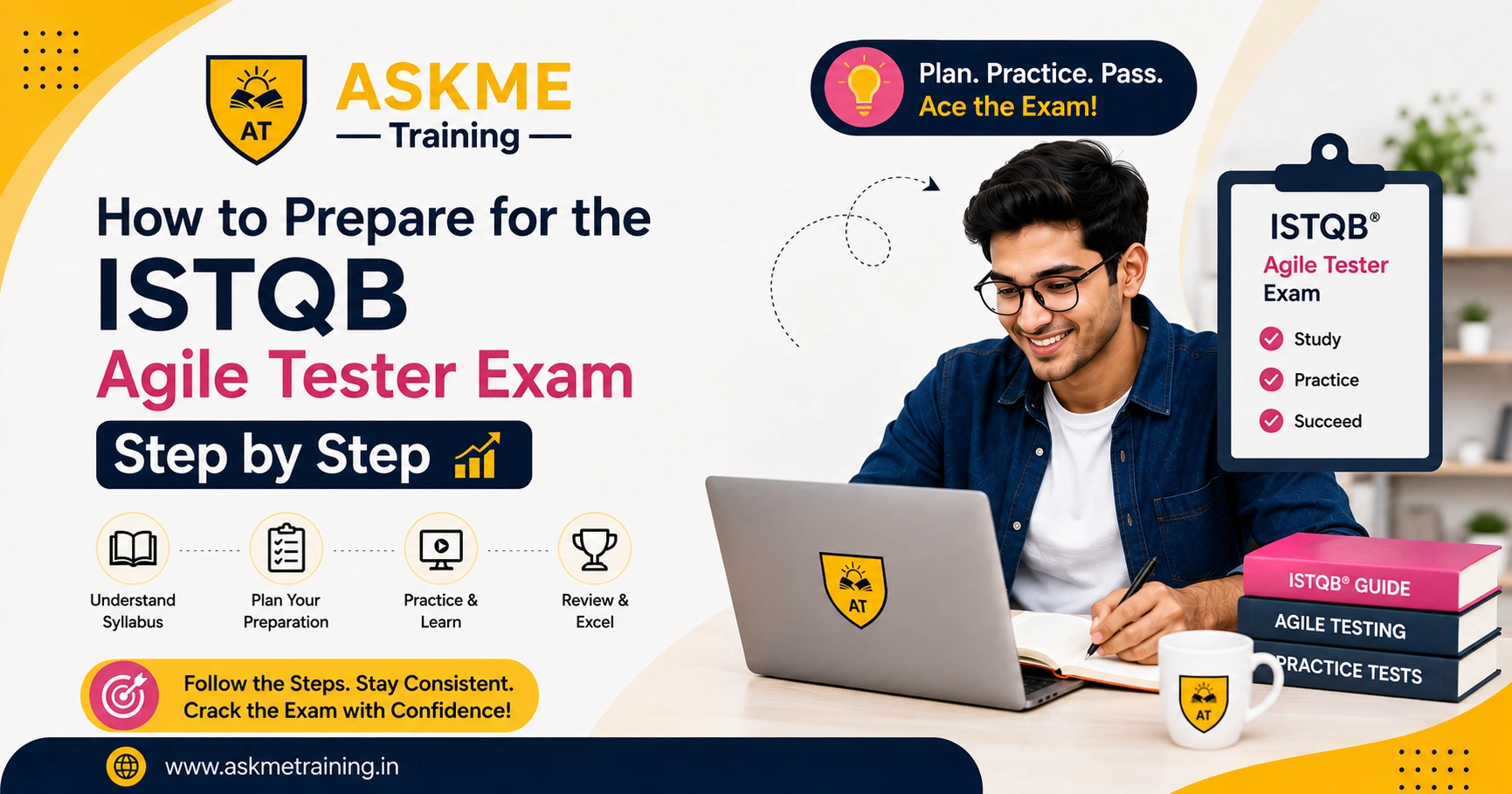
How to Prepare for the ISTQB Agile Tester Exam Step by Step
- By Admin
- Posted on 18/08/2026
Preparing for the ISTQB Agile Tester exam can feel challenging if you are unsure what to study, which syllabus to follow, or how much practice is enough. A structured preparation strategy can make the process easier and more effective.
If you are searching for an ISTQB Agile Tester PDF, ISTQB Online certification, sample questions, or an Agile testing study plan, this guide explains how to prepare step by step.
2026 Update: The ISTQB Certified Tester Foundation Level Agile Tester (CTFL-AT) is currently in its sunset phase. Candidates should check the official ISTQB website for current exam availability, syllabus versions, and transition information before beginning preparation.
What Is ISTQB Agile Tester Certification?
The ISTQB Agile Tester certification helps software testing professionals understand how testing works within Agile development teams.
Key areas include:
* Agile principles and values
* Agile testing practices
* Scrum roles and collaboration
* User stories and acceptance criteria
* Test planning
* Risk-based testing
* Regression testing
* Test automation
* Exploratory testing
* Continuous feedback and improvement
For advanced professionals, ISTQB also offers the Certified Tester Advanced Level Agile Tester (CTAL-AT) certification.
Step-by-Step ISTQB Agile Tester Preparation
Step 1: Identify the Correct Certification
Before studying, confirm which Agile Tester certification you plan to take. Check the latest official syllabus, examination availability, eligibility requirements, and exam structure.
This prevents you from preparing with outdated material.
Step 2: Study the Official ISTQB Agile Tester PDF
Start with the official syllabus PDF rather than relying on random online notes.
Read the syllabus carefully and:
1. Identify the major topics.
2. Review the learning objectives.
3. Highlight unfamiliar terms.
4. Create short revision notes.
5. Connect each concept with a practical testing example.
Your goal should be to understand concepts instead of memorizing definitions.
Step 3: Learn Agile Testing Fundamentals
Build a strong foundation in:
* Agile values and principles
* Scrum roles
* Iterations and incremental development
* Whole-team approach
* User stories
* Acceptance criteria
* Definition of Done
* Test planning
* Test automation
* Exploratory testing
* Regression testing
* Quality risks
For example, if a user story involves adding products to an online shopping cart, think about different scenarios such as adding multiple products, changing quantities, removing products, checking prices, and handling unavailable products.
This scenario-based approach makes Agile testing easier to understand.
Step 4: Practice Sample Questions
Do not wait until the final week to practice.
Solve sample questions after completing each major topic. Maintain a **mistake notebook** containing:
* The question you answered incorrectly
* The related concept
* Why your answer was wrong
* Why the correct answer is right
Review this notebook during your final revision.
Step 5: Follow a Simple 4-Week Study Plan
Week 1 – Fundamentals:
Study Agile principles, terminology, roles, lifecycle, and basic testing concepts.
Week 2 – Agile Testing:
Focus on user stories, acceptance criteria, test planning, risk, test techniques, automation, and collaboration.
Week 3 – Practice:
Complete sample questions and mock tests. Identify weak areas and revise them.
Week 4 – Final Revision:
Review your notes, difficult concepts, mistakes, glossary, and practice tests.
A useful preparation formula is:
Learn → Understand → Practice → Review → Repeat
Benefits of Agile Testing Certification
Agile testing knowledge can help you:
* Understand testing in Agile teams
* Improve communication with developers and stakeholders
* Understand user stories and acceptance criteria
* Strengthen your software testing profile
* Develop better test planning skills
* Understand Agile testing practices
* Prepare for software testing interviews
* Support career growth in QA and testing
However, certification should be combined with practical testing knowledge, projects, tools, and interview preparation.
Career Opportunities
Agile testing skills can support career paths such as:
* Software Tester
* QA Engineer
* Manual Tester
* Automation Tester
* Test Analyst
* Agile Tester
* QA Analyst
* Software Quality Engineer
For freshers, certification can demonstrate structured knowledge, while practical experience helps make the profile more job-ready.
Common Mistakes to Avoid
Avoid these common preparation mistakes:
* Using an outdated ISTQB Agile Tester PDF
* Memorizing answers instead of understanding concepts
* Ignoring learning objectives
* Starting mock tests only at the last minute
* Depending on unauthorized exam dumps
* Skipping revision
* Focusing only on certification and ignoring practical skills
Always use the latest official ISTQB syllabus and examination information.
Expert Tips for ISTQB Preparation
1. Study the syllabus first: It gives you a clear preparation roadmap.
2. Learn through examples: Convert theoretical concepts into real testing scenarios.
3. Practice regularly: Short daily practice is better than last-minute preparation.
4. Review mistakes: Your incorrect answers reveal where you need improvement.
5. Take timed mock tests: This improves confidence and time management.
6. Build practical skills: Combine certification preparation with manual testing, automation, Agile tools, and project experience.
Frequently Asked Questions
Is the ISTQB Agile Tester PDF available online?
Yes. Candidates should use the latest official syllabus and preparation resources provided by ISTQB instead of relying on unofficial or outdated PDFs.
Is ISTQB Online certification available?
Exam delivery options depend on the certification and authorized exam provider. Check the latest information before booking your exam.
Is ISTQB Agile Tester useful for freshers?
Yes. It can help freshers understand Agile testing concepts and demonstrate structured knowledge. Practical skills remain important for getting hired.
How long does ISTQB Agile Tester preparation take?
A learner with basic software testing knowledge may prepare in around four to six weeks with consistent study. The actual duration depends on your experience and available study time.
Are mock tests important for ISTQB preparation?
Yes. Mock tests help identify knowledge gaps, improve time management, and build confidence before the actual examination.
What should I study after Agile Tester Foundation?
Professionals seeking advanced Agile testing knowledge can explore the relevant ISTQB Advanced Level certification, subject to the applicable prerequisites.
Prepare for Your Testing Career with Askme Training Institute
Successful ISTQB preparation is not about memorising hundreds of answers. It is about understanding Agile testing concepts, applying them to practical scenarios, and practicing consistently.
If you are a student, fresher, or working professional looking to strengthen your software testing skills, Askme Training can help you develop a structured, practical, and career-focused learning path.
Visit Askme Training to explore software testing training and take the next step toward becoming a confident, job-ready testing professional.
Learn the concepts. Practice the scenarios. Revise strategically. Get exam-ready with confidence.
