
 Askme Training
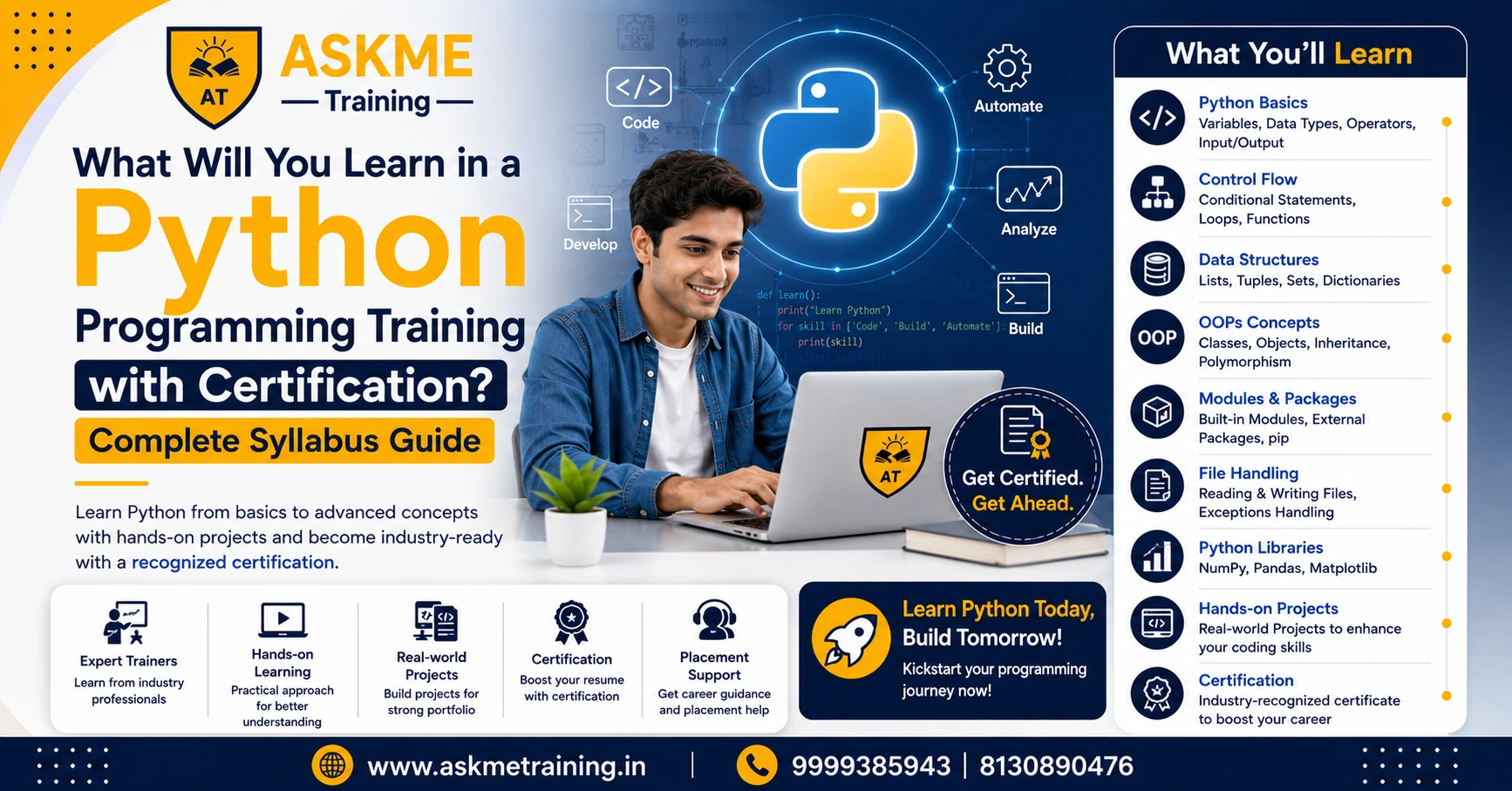
What Will You Learn in a Python Programming Training with Certification?
- By Admin
- Posted on 23/07/2026
With good cause, Python has emerged as one of the most widely used programming languages globally. Python is frequently the first language recruiters want you to know, regardless of your career goals—software development, data analysis, automated testing, AI engineering, or web development.
But one question many students ask is:
"What exactly will I learn in a Python programming training with certification?"
If you're planning to enroll in a Python Course in Noida, this guide will help you understand the complete syllabus, practical projects, career opportunities, and the skills you'll gain throughout the training.
Why Learn Python in 2026?
Technology is evolving rapidly, and Python continues to dominate industries like:
• Artificial Intelligence
• Machine Learning
• Data Science
• Software Development
• Automation Testing
• Web Development
• Cyber Security
• Cloud Computing
• DevOps
Who Should Join a Python Programming Training with Certification?
This course is ideal for:
• College students
• Fresh graduates
• IT professionals
• Manual testers moving into automation
• Software developers
• Data science aspirants
• Business analysts
• Career switchers
• Engineering students
Even if you have never written a single line of code before, Python is beginner-friendly and easy to understand.
Complete Python Programming Course Syllabus
A quality python programming training with certification focuses on practical learning rather than just theory. Here's what you can expect.
Module 1: Introduction to Python
You'll begin with the fundamentals.
Topics include:
• What is Python?
• Why Python is popular
• Installing Python
• IDE setup
• Running Python programs
• Writing your first Python code
Outcome: Understand how Python works and set up your development environment.
Module 2: Python Basics
This module builds your programming foundation.
You'll learn:
• Variables
• Data Types
• Operators
• Input and Output
• Comments
• Type Conversion
Practical Exercise
Build a simple calculator that performs basic mathematical operations.
Module 3: Decision Making and Loops
Programming becomes powerful when your code can make decisions.
Topics covered:
• if statement
• if-else
• Nested if
• Match Case
• For loop
• While loop
• Break
• Continue
• Pass
Project
Create a student grading system.
Module 4: Functions
Functions help write reusable and organized code.
You'll learn:
• Creating functions
• Function arguments
• Return values
• Lambda functions
• Recursive functions
• Scope of variables
Practical Example
Build a library management function.
Module 5: Data Structures
Python provides several built-in data structures.
Topics include:
• Lists
• Tuples
• Sets
• Dictionaries
• Nested collections
You'll also understand:
• Searching
• Sorting
• Iteration
• Data manipulation
Mini Project
Student database management system.
Module 6: Strings and File Handling
Every real-world application deals with files and text.
Topics covered:
• String operations
• String methods
• File reading
• File writing
• CSV handling
• Exception handling
Practical Task
Build a simple employee record management system.
Module 7: Object-Oriented Programming (OOP)
This module prepares you for enterprise-level development.
You'll learn:
• Classes
• Objects
• Constructors
• Inheritance
• Polymorphism
• Encapsulation
• Abstraction
Project
Design a banking application using OOP concepts.
Module 8: Exception Handling
No software is perfect.
You'll learn how to write robust programs using:
• Try
• Except
• Finally
• Raise exceptions
• Custom exceptions
Module 9: Modules and Packages
Topics include:
• Importing modules
• Creating custom modules
• Installing libraries
• Using pip
• Virtual environments
Module 10: Database Connectivity
Learn how Python connects with databases.
Topics:
• SQL basics
• MySQL connectivity
• CRUD operations
• Database queries
Project
Build a Student Management System connected to a database.
Module 11: Python for Automation
This module is especially useful for QA professionals.
You'll learn:
• File automation
• Excel automation
• Email automation
• Web scraping basics
• Introduction to Selenium with Python
Module 12: Mini & Real-Time Projects
Hands-on experience is what employers value the most.
Sample projects include:
• Student Management System
• Library Management
• Banking Application
• Expense Tracker
• Employee Payroll System
• Quiz Application
• Password Generator
• Inventory Management
These projects help build your portfolio and improve interview confidence.
Practical Skills You'll Gain
After completing the course, you'll be able to:
• Write clean Python programs
• Build reusable code
• Debug applications
• Handle files and databases
• Work with APIs
• Create automation scripts
• Understand object-oriented programming
• Build real-world projects
• Prepare for technical interviews
These practical skills are what recruiters often look for in entry-level Python developers.
Benefits of Python Programming Training with Certification
Choosing a structured training program offers several advantages:
• Industry-recognized certification
• Hands-on project experience
• Placement assistance
• Resume building support
• Mock interview preparation
• Live coding practice
• Mentor guidance
• Lifetime learning resources (where offered)
A certification also demonstrates your commitment to learning and can strengthen your resume when applying for jobs.
Career Opportunities After Learning Python
Python opens doors to multiple career paths.
Popular job roles include:
• Python Developer
• Software Engineer
• Automation Test Engineer
• Data Analyst
• Data Scientist
• Machine Learning Engineer
• AI Developer
• Backend Developer
• DevOps Engineer
• Web Developer
As organisations increasingly adopt AI and automation, Python skills continue to be in high demand across industries.
Common Mistakes Beginners Should Avoid
Many learners slow their progress by making avoidable mistakes.
Here are some common ones:
• Learning only theory without practice
• Skipping coding exercises
• Ignoring debugging skills
• Memorizing syntax instead of understanding logic
• Avoiding real-world projects
• Not participating in coding challenges
Consistent practice is the key to becoming confident in Python.
Frequently Asked Questions (FAQs)
1. What is included in a Python programming training with certification?
Most programs include Python fundamentals, data structures, OOP, file handling, databases, automation basics, real-world projects, interview preparation, and a course completion certificate.
2. Is Python suitable for beginners?
Yes. Python is widely regarded as one of the easiest programming languages to learn because of its simple and readable syntax.
3. How long does it take to complete a Python programming course?
Most training programs can be completed in 2–4 months, depending on the learning format and schedule.
4. Do I need prior programming knowledge?
No. Most beginner-level Python courses start from the basics and gradually move to advanced concepts.
5. What jobs can I get after learning Python?
You can pursue roles such as Python Developer, Automation Test Engineer, Data Analyst, Backend Developer, AI Engineer, or Software Developer.
A well-structured python programming training with certification gives you the technical knowledge, practical experience, and confidence needed to solve real-world problems and prepare for interviews. If you're searching for a python programming course in Noida, choose a program that emphasizes hands-on projects, mentorship, and career support rather than theory alone.
Ready to build a successful career in programming?
At Askme Training Institute, we offer industry-focused python programming training with certification designed for students, freshers, and working professionals. Our training includes expert-led sessions, hands-on projects, interview preparation, and placement assistance to help you become job-ready.
