
 Askme Training
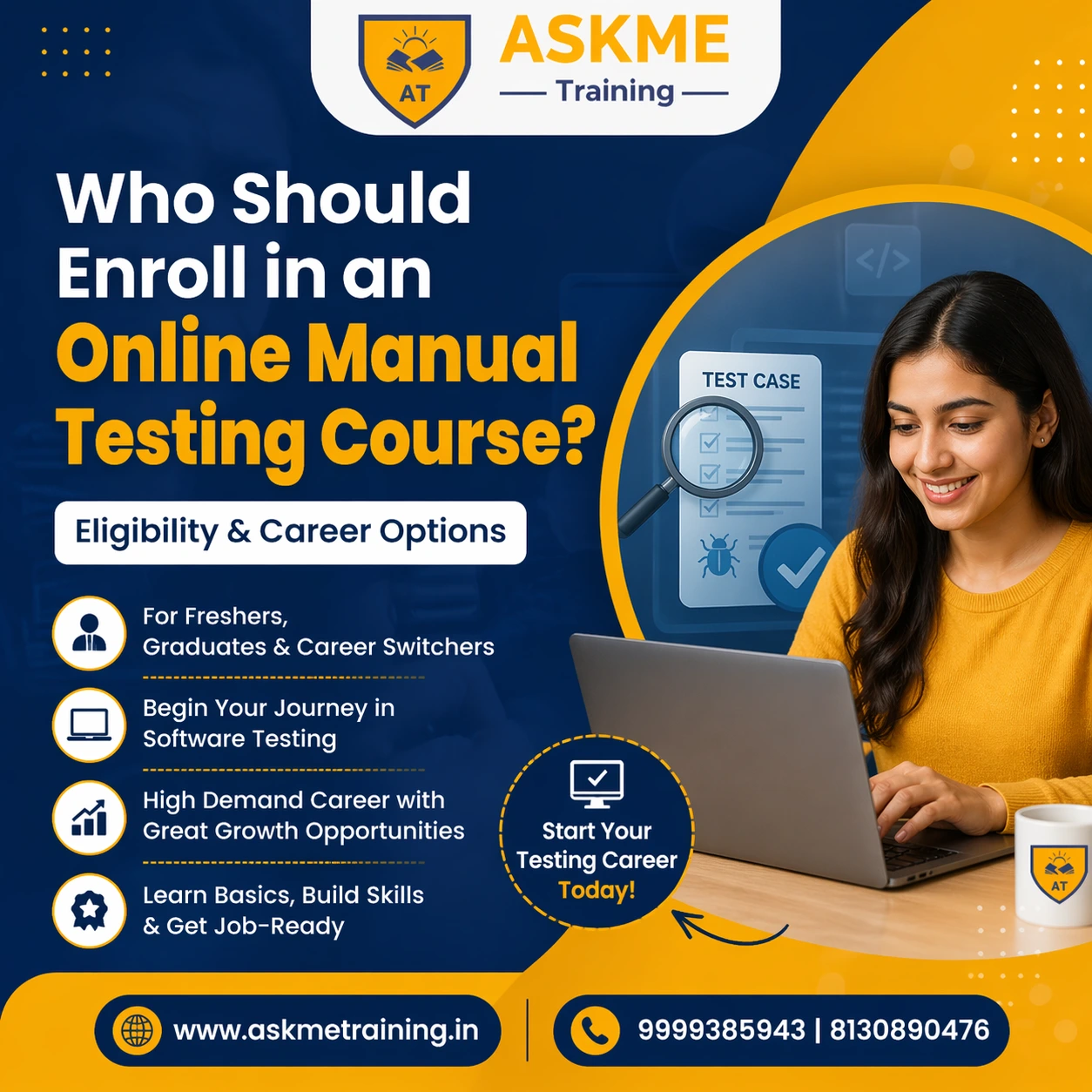
Who Should Enroll in an Online Manual Testing Course? Eligibility & Career Options
- By Admin
- Posted on 21/04/2026
In today’s fast-growing IT industry, software quality plays a crucial role in ensuring user satisfaction. This is where manual testing becomes essential. If you’re planning to enter the tech field without deep coding knowledge, enrolling in an Online Manual Testing Course can be a smart career move.
But the most common question is:
Who should actually enroll in a manual testing course?
Is it only for IT students, or can non-technical candidates also apply?
In this detailed guide, we’ll cover eligibility, ideal candidates, and career opportunities after completing an online manual testing course.
What is an Online Manual Testing Course?
An online manual testing course teaches you how to test software applications manually to identify bugs, errors, and usability issues before release.
Key topics covered:
- Software Testing Life Cycle (STLC)
- Software Development Life Cycle (SDLC)
- Test case design & execution
- Bug reporting & tracking tools (like Jira)
- Functional and non-functional testing
- Agile testing methodologies
Unlike automation testing, manual testing does not require coding skills, making it perfect for beginners.
Who Should Enroll in an Online Manual Testing Course?
Let’s break this down based on different profiles 👇
1. Fresh Graduates (IT & Non-IT)
If you’ve recently completed your graduation and are unsure about your career path, a manual testing course online can be your gateway into IT.
Ideal for:
- B.Tech / BCA / MCA students
- B.Com / BBA / BA graduates
- Students from non-technical backgrounds
Why it works:
Manual testing requires logical thinking and attention to detail rather than coding expertise.
2. Career Switchers
Looking to switch from a non-technical job to IT? Manual testing is one of the easiest entry points.
Suitable for:
- Banking professionals
- Sales & marketing executives
- Customer support professionals
Why choose manual testing?
- Low entry barrier
- High demand in IT companies
- Faster learning curve
3. Working Professionals Seeking Growth
If you’re already in IT but stuck in a non-growth role, learning manual testing can help you transition into QA roles.
Examples:
- Technical support engineers
- Data entry operators
- Junior developers
4. Students Looking for Short-Term Job-Oriented Courses
Many students prefer short-term certification courses that lead to quick employment. An online software testing course is perfect for this.
Duration: 2–4 months
Outcome: Job-ready skills
5. Freelancers & Remote Job Seekers
Manual testing also opens doors to freelancing and remote opportunities.
You can work as:
- Freelance QA tester
- Bug tester on platforms
- Remote QA analyst
Eligibility for an Online Manual Testing Course
One of the biggest advantages of manual testing is its flexible eligibility criteria.
Basic Requirements:
✔ Graduation (any stream preferred, but not mandatory)
✔ Basic computer knowledge
✔ Understanding of English (for documentation)
No Need For:
❌ Programming knowledge
❌ Technical background
❌ Prior IT experience
This makes it one of the most accessible IT courses for beginners.
Skills You Will Develop
An online manual testing course helps you build both technical and soft skills.
Technical Skills:
- Writing test cases
- Identifying bugs
- Understanding application flow
- Using testing tools (Jira, TestRail)
Soft Skills:
- Analytical thinking
- Attention to detail
- Communication skills
- Problem-solving ability
Career Options After Completing a Manual Testing Course
After completing your course, you can explore multiple career paths in software testing.
1. Manual Tester
The most common entry-level role.
Responsibilities:
- Execute test cases
- Identify bugs
- Report defects
2. QA Analyst (Quality Assurance)
A slightly advanced role involving deeper analysis.
Tasks include:
- Test planning
- Requirement analysis
- Process improvement
3. Software Test Engineer
In this role, you may eventually transition into automation testing.
4. Business Analyst (Optional Path)
With experience, manual testers can move into business analysis roles.
5. Freelance QA Tester
Work independently and earn through global projects.
Salary Expectations in India
Here’s a rough salary range after completing an online manual testing course in India:
- Fresher: ₹2.5 LPA – ₹4 LPA
- 1–3 Years Experience: ₹4 LPA – ₹7 LPA
- Experienced QA: ₹8 LPA+
Why Choose an Online Manual Testing Course?
1. Learn Anytime, Anywhere
Flexible learning schedule for students and professionals.
2. Cost-Effective
Online courses are more affordable than classroom training.
3. Job-Oriented Training
Most courses include:
- Real-time projects
- Interview preparation
- Resume building
4. Placement Assistance
Many institutes provide job support and referrals.
Online Manual Testing vs Automation Testing
|
Feature |
Manual Testing |
Automation Testing |
|
Coding Required |
No |
Yes |
|
Difficulty Level |
Easy |
Moderate |
|
Best For |
Beginners |
Experienced professionals |
|
Learning Time |
Short |
Longer |
Pro Tip: Start with manual testing, then upgrade to automation later.
How to Choose the Right Online Manual Testing Course?
Before enrolling, consider:
✔ Updated syllabus
✔ Industry-relevant tools
✔ Live projects
✔ Placement support
✔ Trainer experience
FAQ Section
1. Who can enroll in an online manual testing course?
Anyone with basic computer knowledge, including freshers, graduates, and working professionals, can enroll.
2. Do I need coding skills for manual testing?
No, manual testing does not require programming knowledge.
3. How long does it take to learn manual testing?
It usually takes 2 to 4 months to become job-ready.
4. Is manual testing a good career option in 2026?
Yes, manual testing remains a strong entry-level role in the IT industry.
5. Can non-IT students learn manual testing?
Absolutely. Many non-technical candidates successfully transition into QA roles.
An Online Manual Testing Course is one of the best entry points into the IT industry, especially for beginners and non-technical candidates. With minimal eligibility requirements, strong job demand, and quick learning time, it offers a practical path to a stable and rewarding career.
Whether you’re a fresher, career switcher, or working professional, manual testing can help you build a solid foundation in software quality assurance and open doors to advanced roles in the future.
Looking to start your career in software testing?
Join Askme Training’s Online Manual Testing Course today and get:
✔️ Live instructor-led classes
✔️ Real-time projects
✔️ Interview preparation
✔️ 100% placement assistance
Enroll now and take your first step toward a high-paying IT career.
